
Job boards are one of the simplest online businesses: connect employers with candidates in a specific niche, then charge for access. When the niche is clear and the audience is targeted, a job board can generate recurring revenue with surprisingly low ongoing effort, especially once SEO and job aggregation are working.
This guide explains how to create a job board step-by-step, including the parts most "inspiration" posts skip: job aggregation, Google for Jobs schema, canonical URL strategy, indexing, expired job handling, and practical compliance basics like GDPR and data retention.
By the end, you'll have a clear roadmap whether you're building a standalone job board business, monetizing an existing newsletter or community, supporting an association, or launching a recruiting channel for your organization with your new job board website. (Still weighing whether a job board is the right move? See 5 reasons to start a job board with real revenue data and realistic timelines.)
How to create a job board in 9 steps:
- Understand the type of job board you're building
- Pick a small, winnable niche
- Choose the right platform
- Set up the foundation
- Solve the chicken-and-egg problem with aggregation
- Get SEO right (especially Google for Jobs)
- Add monetization
- Layer in distribution channels
- Cover legal and compliance
Step 1: Understand the different types of job boards
Before picking a niche, get clear on what type of job board you're building. The model shapes everything: your monetization strategy, the features you need, how you'll source jobs, and what success actually looks like. (For a deeper look at marketplace economics, network effects, and which business model fits your operator type, see our business models guide.)
Standalone job board business
Many successful job boards are businesses in their own right, often focusing on a specific industry. The model is simple: find an underserved corner of the job market, become the definitive resource, and charge employers (or more recently, job seekers) for access.
Himalayas and Venture Capital Careers both run this playbook. Revenue comes from job posting fees, featured placements, resume database access, and job seeker subscriptions.
The leverage is in your email list and search rankings. A list of 50,000 engaged subscribers in a specific niche is worth far more to employers than generic traffic, and it directly determines what you can charge.
If you're building a job board business, you should prioritize tiered monetization options, strong SEO for organic discovery, and email alerts that actually get opened.
Association and non-profit job boards
Professional associations, trade groups, and chambers of commerce use job boards primarily for non-dues revenue. Done well, a job board becomes one of the top revenue generators while increasing member value. It's the rare initiative that makes money and improves retention.
The dynamic differs from standalone boards: you already have the audience. The challenge is activating employers and demonstrating the value of your member base to attract potential candidates.
Associations should prioritize member-specific pricing tiers, integration with your AMS, and member-only features that justify the pricing gap between member and non-member rates.
One wrinkle: The IRS can classify job board revenue as Unrelated Business Income for non-profits. Structure matters, so talk to an accountant who knows association taxation before launching.
Staffing and recruitment agency job boards
Staffing agencies and recruiters routinely pay $400K+ a year to Indeed, ZipRecruiter, and LinkedIn. Building a niche job board lets agencies slash costs while building candidate databases they own rather than rent.
If this is you, prioritize building a resume database with advanced filtering, customizable application forms, ATS integration, and white-label branding.
Community and creator job boards
Newsletter operators, podcast hosts, and community founders are increasingly adding job boards as a monetization layer. The audience already exists, the job board converts attention into recurring revenue without the downsides of sponsorships or ads.
Work With Indies built a large community on a Discord server before monetizing through job postings.
Look for a platform that allows you to match your existing brand (or build your own), newsletter integration for featuring jobs, and low operational overhead.
Other job board types
University and career services job boards connect students and alumni with job opportunities. Success metrics differ from commercial boards: you're optimizing for employment outcomes, not revenue.
VC and accelerator portfolio job boards aggregate openings from portfolio companies. Most don't charge for postings. The value is in supporting portfolio success.
Job boards as content marketing bring qualified traffic and build email lists for SaaS companies. The board itself might not charge anything; revenue comes indirectly through product sales.
Reverse job boards flip the model: candidates create profiles and employers pay to browse and contact them. They work in small, talent-scarce niches and have their own launch playbook, since candidate supply can't be aggregated the way job listings can.
Step 2: Start with a small, winnable niche
For 30+ specific niche ideas with validation data, see our guide to profitable niche job board ideas.
The biggest mistake we see: targeting everyone. Indeed and LinkedIn already do that, with hundreds of millions of monthly visitors and billions in market cap. You win by going where they don't serve well. And you can always expand your niche in the future.
Successful niche job boards share three characteristics:
- A defined audience with shared identity
- Employers willing to pay a premium for targeted access
- Enough job volume to sustain activity without constant manual effort
Niche categories that consistently generate revenue
- Industry verticals narrow by sector: healthcare administration, renewable energy, fintech, construction management. These work because employers struggle to find qualified candidates on general boards, and they'll pay $200-500 per posting for targeted access. Dice charges $399-495 per job posting in the tech vertical.
- Demographic focus serves specific groups: working mothers returning to careers, veterans transitioning to civilian roles, professionals over 50. These niches build loyal communities because job seekers feel seen.
- Geographic specificity owns a location: Orlando jobs, Berlin tech, Japan expat positions. Japan Dev doesn't try to cover all developer jobs, just Japan. That constraint is the strategy.
- Work arrangement niches exploded post-2020: remote-only positions, four-day workweek companies, async-first teams. We Work Remotely charges $299 per job posting. Himalayas charges job seekers $9/month for AI tools (resume builder, interview trainer, cover letter generator) on top of their free remote jobs board, proving job seeker monetization can work in the right context.
- Skill-based verticals attract premium employers: Rust developers, AI/ML engineers, blockchain specialists. MoAIJobs focuses exclusively on AI roles and reached profitability within months.
Validate before you build
Before investing time into building your job board, you need to confirm your niche can actually support a business. That means validating search demand, employer fragmentation, job posting velocity, willingness to pay, and community engagement.
We built a complete 5-signal validation framework with quantitative pass/fail thresholds and a scoring system you can run in under two weeks. Use it to score your niche before committing to a build.
Step 3: Select a platform or build your own
Your platform choice determines launch speed, ongoing costs, customization flexibility, and maintenance burden. For 80%+ of new job board operators, SaaS is the right answer. (Not sure which path fits your situation? Our build vs buy guide covers the decision framework, our startup costs guide covers what you'll actually spend in Year 1, and our job board theme vs. job board software comparison helps you decide between self-assembled themes and dedicated software.)
SaaS job board platforms
Dedicated job board software handles infrastructure, payments (often integrating with services like Stripe for credit card processing), job management, and SEO optimization out of the box. Most boards launch in minutes, not months.
Cavuno (our platform) takes an AI-native approach. Use the hosted board for the fastest launch, or use the SDK when you want Cavuno’s managed job board backend with a custom frontend in your own framework. Automated job aggregation and hybrid search work with either path. Pricing starts at $39/month for 500 active jobs.
Cavuno Companion is included on every plan to help you run and grow the board. Ask it about setup, product workflows, growth, or job-post pricing. When you are signed in, it can use available account details such as your plan and usage to make its guidance more relevant. If you want a person or it cannot help, Cavuno's founders continue in the same conversation.
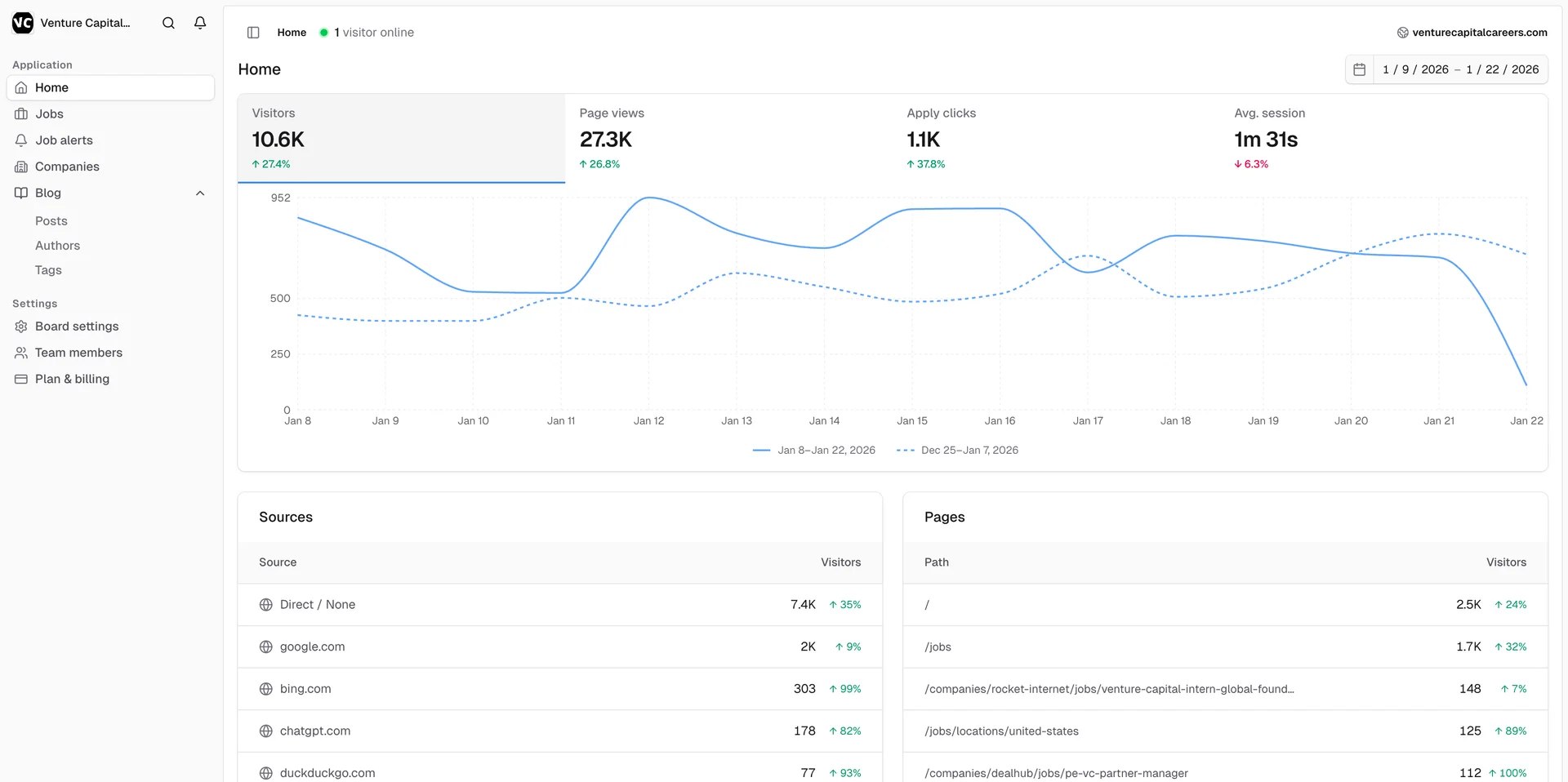
JBoard starts at $249/month and powers 400+ job boards across 54+ countries. Strong reputation with extensive job aggregation capabilities.
Niceboard built their name on design quality, with case studies from associations like AAPC and ACLM. Reports $1.7M+ paid out to board operators. Pricing requires a sales conversation.
SmartJobBoard targets enterprise and associations with 17+ years in the market. Revenue share models available.
Job Boardly offers aggressive pricing at $50/month, plus a paywall feature for job seeker subscriptions.
For a deeper comparison, read our full guide on the best job board software.
Other options
WordPress with plugins adds job board functionality to existing sites. The trade-off is maintenance: WordPress security, plugin conflicts, and hosting become your responsibility. See our WordPress job board plugins guide for a detailed comparison of options, our job board theme vs. job board software comparison for the higher-level decision, or our open source job board software guide for self-hosted alternatives.
No-code builders (Webflow, Framer, Wix) can create visually stunning boards but lack native job alerts and aggregation. Best for curated, editorial job boards.
For specific template recommendations across all these platforms, see our job board templates guide.
AI-assisted development (Bolt.new, Replit, Cursor) can generate functional MVPs from prompts. Best for technical founders validating demand before committing to SaaS fees. Cavuno's AI website builder takes a different cut at the same idea: the AI builds the frontend on top of a finished job board system, so aggregation, payments, and SEO are already there.
Custom development ($5,000–$200,000+) only makes sense when your requirements genuinely exceed what SaaS platforms offer.
The decision framework
- Want to launch this week? → SaaS platform
- Already running WordPress with an audience? → WordPress plugins
- Design control matters more than automation? → No-code builder
- Technical founder testing an idea? → AI-assisted MVP
- Genuinely unique requirements? → Custom development
Step 4: Configure your foundation
Before you start adding jobs, get the fundamentals right. These decisions are harder to change later.
Domain name
Get a .com if possible. For niche boards, [niche]jobs.com or [niche]careers.com follows proven patterns. Avoid hyphens, unusual TLDs, and anything longer than ~20 characters.
Logo and visual identity
You don't need a professional designer to launch. Pick 2-3 colors and use them consistently. Match typography to your audience's expectations. Developer boards can run minimal and dark-mode forward; association boards need a conservative, trustworthy feel. Cavuno includes a built-in logo generator, and the AI website builder shapes the design around your brand colors, with light and dark appearance on request.
Essential configuration
Job alerts: Enable notifications from day one. This is your email list builder. Every subscriber is someone you can reach with new jobs, and your list size directly determines what you can charge employers.
Approval workflow: Decide whether jobs publish automatically or require manual review. For aggregated jobs, automatic makes sense. For paid posts, manual review lets you enforce high-quality standards.
Category and location taxonomies: Set these up to match your niche before adding jobs. Changing structure after you have hundreds of jobs is painful.
SEO metadata: Configure default title patterns and meta descriptions per page type. Your homepage title should include your primary keyword or brand name.
Analytics and tracking
Set up Google Search Console (essential for SEO) and web analytics like Google Analytics so you have baseline data from day one.
Step 5: Solve the chicken-and-egg problem with job aggregation
Job seekers won't visit a board without jobs. Employers won't pay to post without traffic. Job aggregation solves this by populating your board with relevant open positions from day one. Learn how job board aggregation works and how to set it up.
How aggregation works
Aggregation tools crawl public career pages, existing job boards, and ATS systems to import relevant job openings automatically. The pipeline: identify sources → extract job data → normalize formats → deduplicate listings → validate locations → publish to your board. This process is known as job wrapping. Some operators consider building their own scrapers, but the maintenance and legal complexity usually outweigh the benefits.
Quality varies dramatically between platforms. Common complaints:
- Duplicate listings when the same job appears across multiple sources
- Location data problems showing jobs tagged to wrong cities
- Zombie jobs that stick around after the original posting is filled
- Niche bleed when job search filters aren't tight enough
Cavuno addresses these through URL normalization, location hierarchy validation, and automatic expiry detection when source listings disappear during daily syncs.
Your aggregation options
Partner job feeds from networks like Appcast, Talroo, and Adzuna operate on a CPC or CPA model. They provide jobs; you display them; they pay you per click or application. Revenue is modest but offsets costs while you build.
Job backfilling services give you access to large aggregated databases. Cavuno includes rule-based backfilling up to your plan's active job limit.
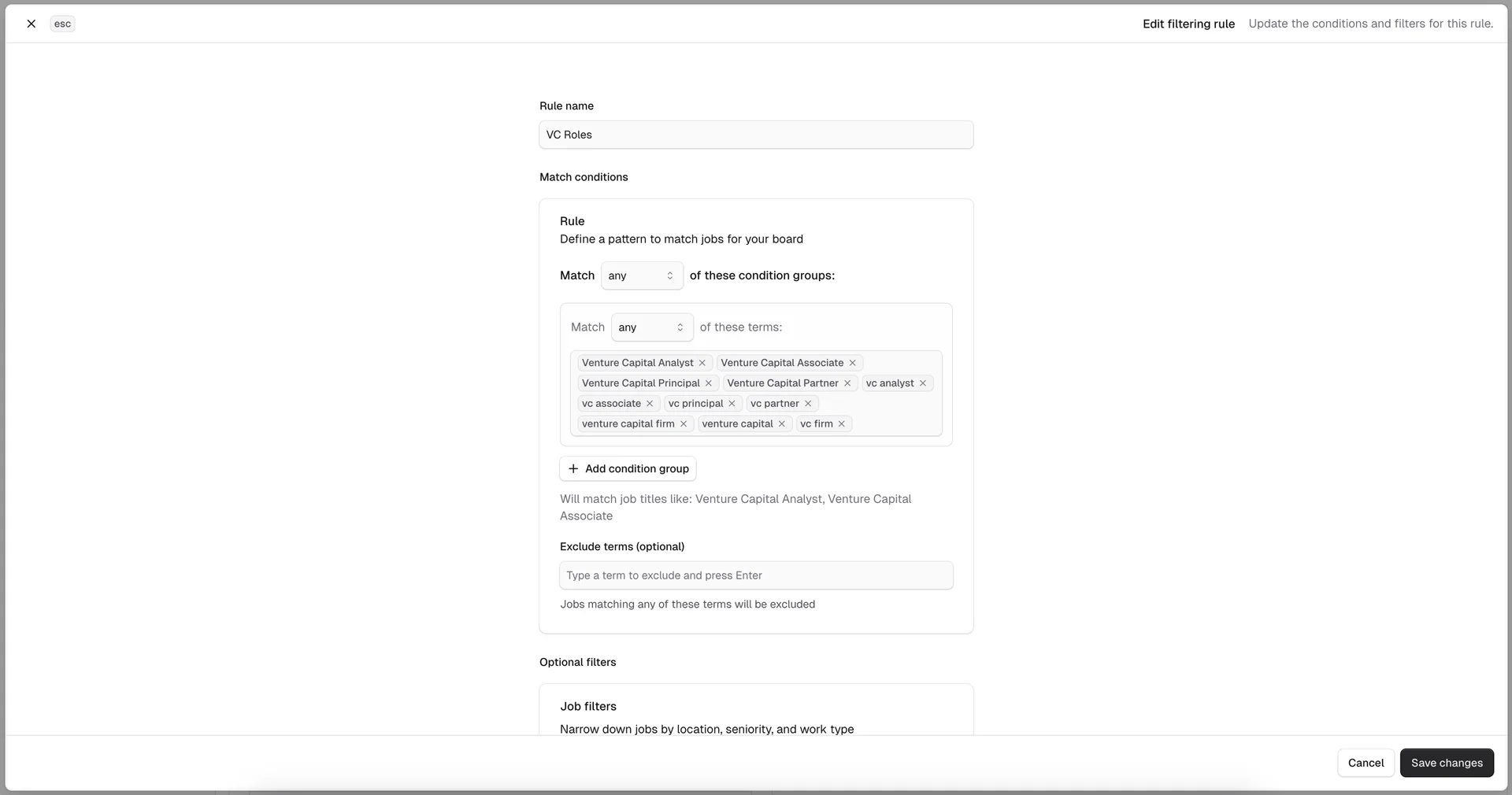
Direct ATS integrations connect to Greenhouse, Lever, Workday, and other applicant tracking systems.
Manual curation doesn't scale but ensures quality for highly specialized niches.
Job backfill best practices
Start with tight filters. Two hundred genuinely relevant jobs beat two thousand where half are mismatches. Job seekers learn quickly whether your board respects their time.
Build exclusion rules progressively. Block sources that consistently provide poor data. Exclude job types that don't fit.
Monitor daily at first. Refine your rules based on what you observe. After the first month, weekly reviews are usually sufficient.
The goal: transition to direct posts
Aggregation gets you started, but it's not the end state. The progression:
- Launch with aggregation to give job seekers a reason to visit
- Build organic traffic through SEO and content marketing
- Capture emails through job alerts
- Approach employers once you have traffic and a list to show
- Shift the mix from aggregated to direct paid posts
Step 6: Master job board SEO
SEO is where job boards are won or lost. Unlike most websites where SEO is one channel among many, for job boards it's often the channel. For a comprehensive deep-dive into job board SEO strategies, see our complete job board SEO playbook.
Part 1: Google for Jobs
Google for Jobs shows an interactive panel with filtered listings before traditional search results. If your jobs aren't appearing there, you're invisible to a significant segment of job seekers.
Required schema fields for Google to index your listings:
title: The job title (use standard titles, not internal codes)description: Full job description in HTML formatdatePosted: When posted, in ISO 8601 formathiringOrganization: Company name, URL, and logojobLocation: Full address withaddressCountry(for remote jobs, usejobLocationType: "TELECOMMUTE"withapplicantLocationRequirementsinstead)
Recommended fields that significantly affect visibility:
baseSalary: Jobs with salary data get preferential treatmentemploymentType: FULL_TIME, PART_TIME, CONTRACTOR, etc.validThrough: Expiration date (required when the job has one)directApply: Boolean indicating whether applications happen on your siteidentifier: Your ATS requisition ID, used by Google to deduplicate listings across siteseducationRequirements(beta): The credential level needed (bachelor degree,professional certificate,no requirements, etc.)experienceRequirements(beta): Minimum work experience in months (e.g., 36 for three years)experienceInPlaceOfEducation(beta): Set totruewhen work experience can substitute for formal education
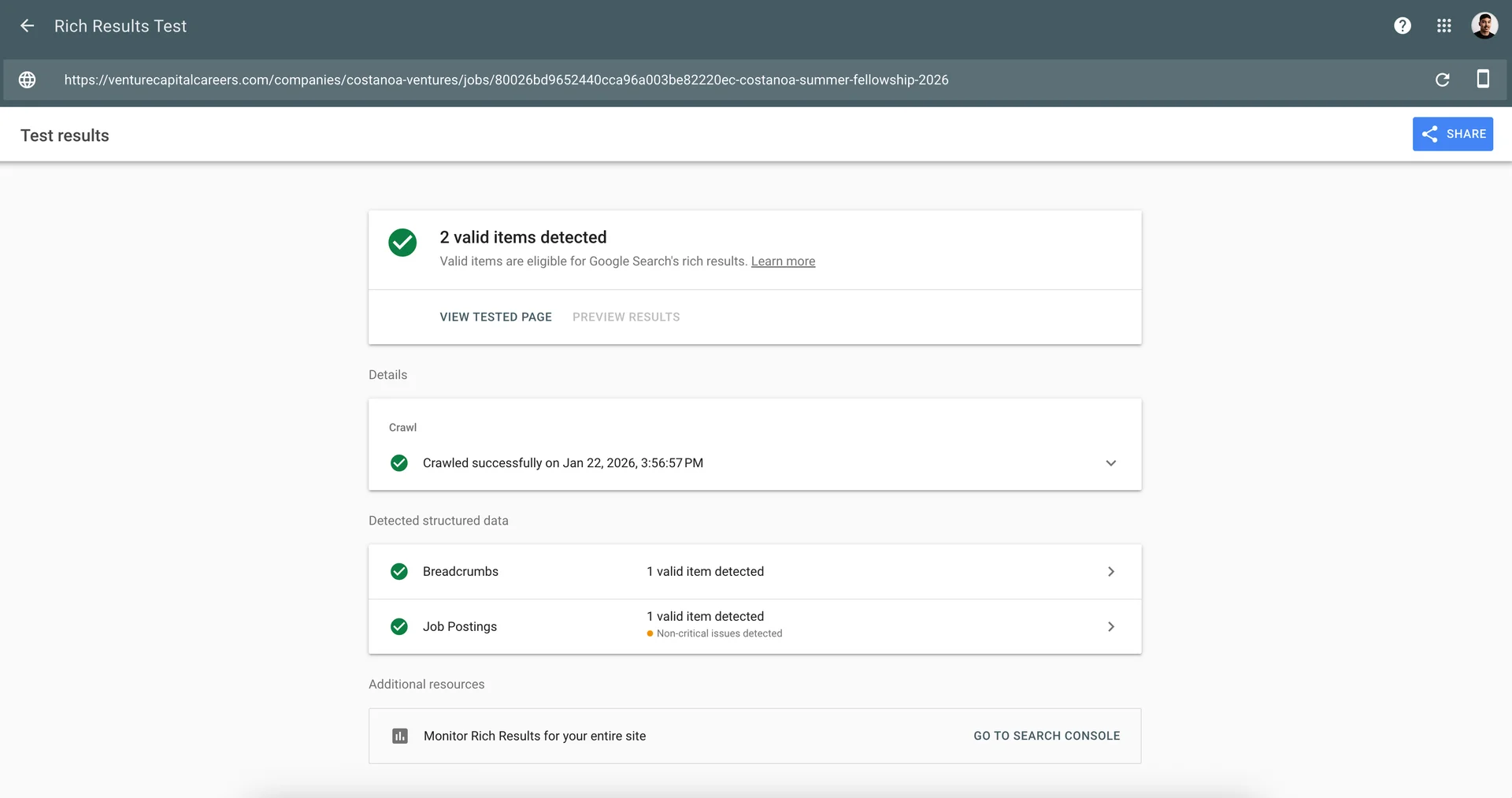
Most job board platforms generate this schema automatically. Cavuno generates valid JobPosting schema on every listing with no manual configuration needed. Verify your implementation using Google's Rich Results Test.
The Indexing API notifies Google immediately when jobs are posted, updated, or removed, versus waiting days for standard crawling. Pair it with IndexNow for instant coverage on Bing, Yandex, and other search engines.
Handling expired jobs. Google recommends three options:
- Set
validThroughto a past date (simplest approach) - Return a 404 or 410 status code (most definitive)
- Remove JobPosting structured data from the page (keeps page indexed for traditional search while removing from Google for Jobs)
Part 2: Technical foundations
The three Core Web Vitals to monitor:
- LCP (Largest Contentful Paint): How fast main content loads. Target under 2.5 seconds.
- INP (Interaction to Next Paint): How responsive the page is to clicks and taps. Target under 200ms.
- CLS (Cumulative Layout Shift): How much the page jumps around while loading. Target under 0.1.
You can measure these on PageSpeed Insights. Common killers: unoptimized company logos, too many jobs per page, accumulating third-party scripts.
Canonical URLs. Job boards accidentally create duplicates through filtering and sorting. Every filterable page should include a <link rel="canonical"> tag pointing to the preferred URL.
Crawl budget. For large boards (10,000+ jobs), block low-value URLs in robots.txt:
Sitemaps. Ensure job listings appear with accurate lastmod dates. Only include canonical, indexable URLs.
Part 3: Programmatic SEO
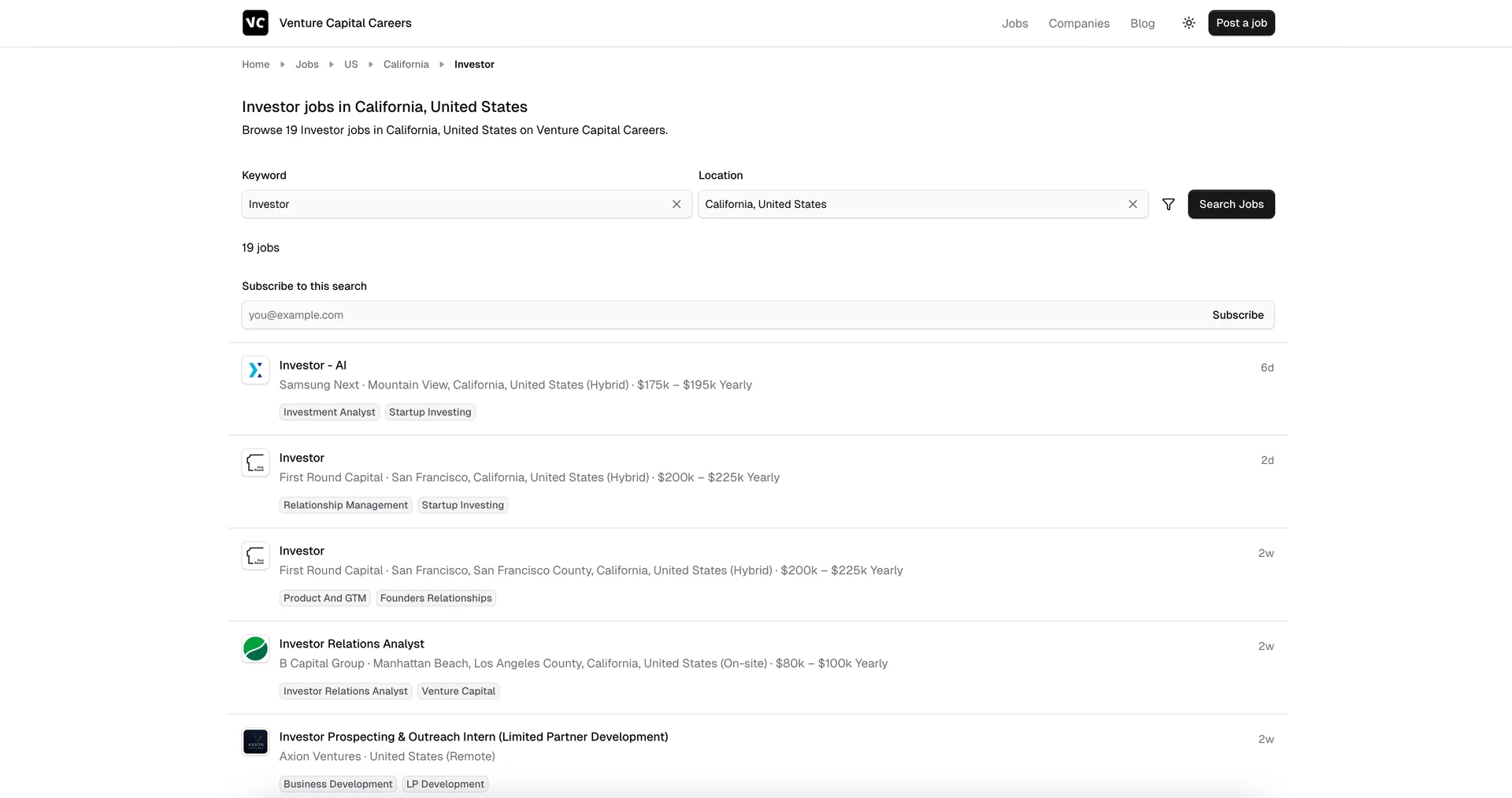
A board with 50 job categories and 20 locations can generate 1,000+ unique programmatic landing pages, each targeting a specific long-tail query like "Marketing jobs in Austin."
The thin content trap. Google penalizes "doorway pages" with low value. Solutions:
- Add unique content to category and location pages (salary data, market context)
- Set minimum job thresholds (don't index pages with fewer than 5-10 jobs)
- Build internal linking between related pages
Part 4: Content and links
We recommend that you create at least 20 blog posts to build topical authority in your niche.
Content that works:
- Salary guides attract both seekers and employers benchmarking offers. This content is especially effective because it attracts both job seekers (researching offers) and employers (benchmarking compensation)
- Career roadmaps answer "how do I break into [industry]?"
- Role explainers answer "what does a [role] actually do?"
- Interview question banks attract high-intent seekers who are in the interview phase
- Resume and cover letter examples and templates help attract people who are actively searching for a job
- University career centers maintain resource pages (search
site:.edu "career resources" [your niche]) - Original research with salary data earns citations naturally
- Industry partnerships with associations and publications
Part 5: Measuring success
Expect 3-6 months before significant organic traffic materializes. Track monthly: organic traffic, indexed pages, click-through rate, keyword rankings, and backlink growth.
Common job board problems:
- "Duplicate without user-selected canonical": fix canonicalization
- "Crawled - currently not indexed": add more value or noindex intentionally
- "Structured data policy violation - JobPosting on expired job": remove zombie jobs immediately
Step 7: Build your monetization engine
Most job boards need 5,000-10,000 monthly visitors before monetization becomes meaningful. That doesn't mean wait to set up revenue streams. It means your early strategy should match realistic traffic expectations. (For a deep dive into 15 revenue models ranked by stage, see our job board monetization guide.)
Paid job postings
Paid postings represent 70-80% of traditional job board revenue.
Pricing by niche:
| Niche | Typical 30-Day Post | Premium/Featured |
|---|---|---|
| General/Entry-level | $50-150 | +$50-100 |
| Tech/Engineering | $200-400 | +$100-200 |
| Healthcare | $200-350 | +$100-150 |
| Executive/C-Suite | $400-600 | +$200-300 |
Start lower, then raise prices. When launching, price 20-30% below where you want to end up. Once you prove employers get qualified applicants, raise prices.
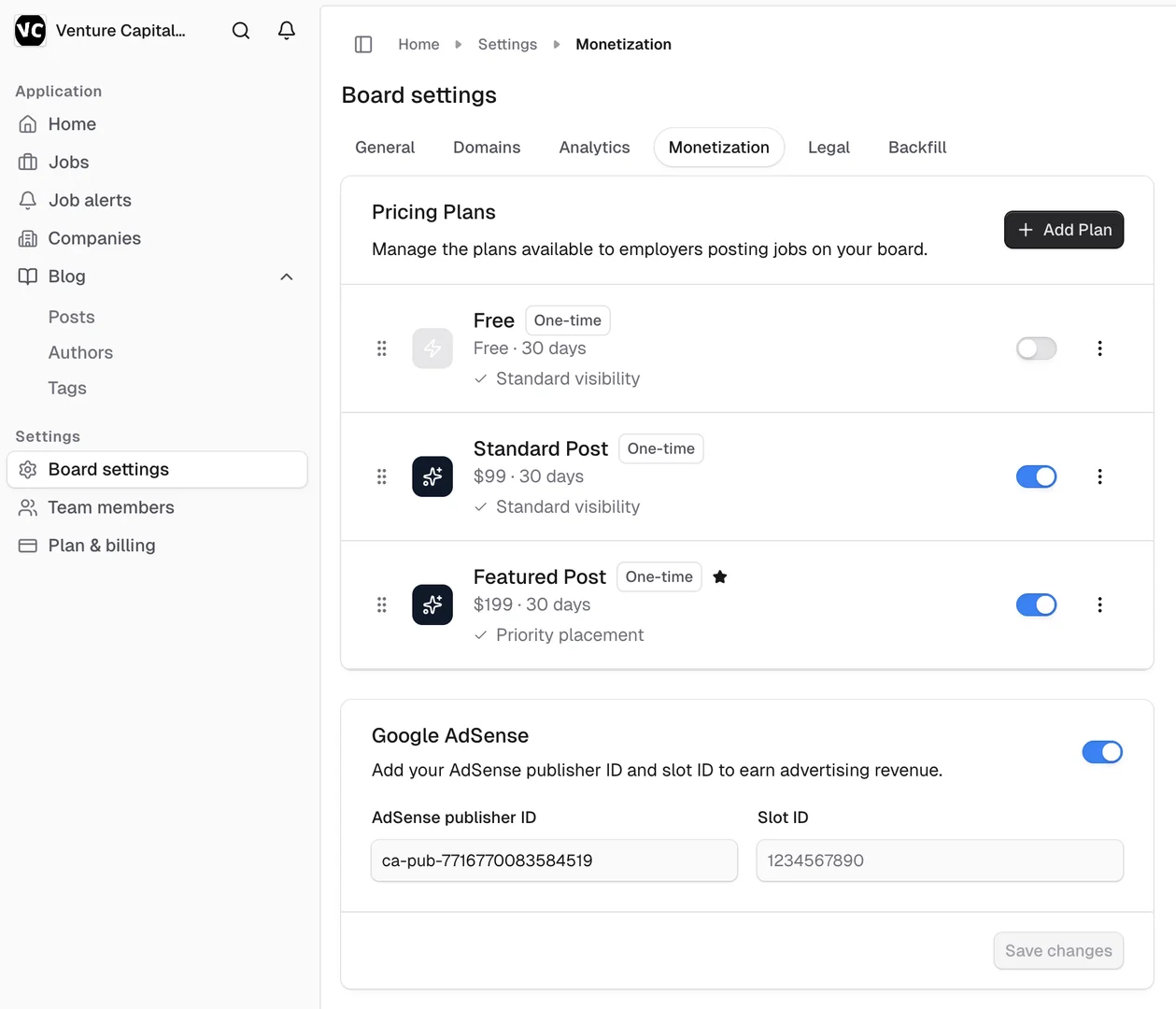
Creating posting tiers. A common structure:
- Basic ($99-149): Standard 30-day listing
- Featured ($249-349): Homepage placement, highlighted in search, included in email alerts
- Premium ($449-599): Social promotion, newsletter feature, extended duration
Employer subscriptions
One-time posts create lumpy revenue. Subscriptions create predictable monthly income.
- Credit-based: $199/month for 5 job post credits
- Unlimited posting: $499-999/month for unlimited open positions
Don't lead with subscriptions when launching. Start with per-post pricing, then offer subscriptions to repeat customers.
Additional revenue streams
Premium placements: Homepage featured section ($99-199 for 7-14 days), email newsletter inclusion ($50-150), social media promotion ($25-75).
Resume database access: Charge $200-500/month for employers to search and contact candidates. Requires 1,000+ active profiles to be valuable.
Programmatic advertising: Google AdSense generates $2-8 CPM. A board with 50,000 monthly pageviews might generate $100-400/month. This is meaningful as supplemental income, not as a primary model.
Affiliate programs: Resume services, career tools, and job backfill providers pay 10-30% commissions when you refer job seekers or display their listings. Low effort to implement and scales with traffic.
Job seeker subscriptions: An emerging model flips the traditional approach: charge job seekers instead of (or in addition to) employers. This works when your job curation or access justifies the cost. Remote Rocketship charges job seekers for access to their curated remote job listings. Himalayas charges $9/month for AI tools (resume builder, interview trainer, cover letter generator) layered on top of their free job board.
The revenue math
A niche job board with 20,000 monthly visitors, 2% employer conversion rate, and $200 average job post price:
- 20,000 visitors × 2% employer traffic × 5% conversion = 20 posts/month
- 20 posts × $200 = $4,000/month
Add subscriptions, newsletter sponsorships, and AdSense, and you're at roughly $6,000/month. Scale to 100,000 visitors with the same ratios and you're at $30,000/month.
Step 8: Layer in additional marketing channels
Most boards that reach profitability rely heavily on organic search plus one or two other channels they've mastered. Better to dominate one channel than dabble in five. For a full breakdown of all 20 marketing channels and how to prioritize them by growth stage, see our complete job board marketing guide.
Email: Start with what you own
Email is your most valuable marketing asset. Unlike social followers or search rankings, your email list is yours. No algorithm changes, no platform risk. See our full guide on email marketing for job boards for the complete strategy.
Job alerts are your list-building engine. The size of your list directly determines what you can charge employers.
Newsletter strategy: Build a weekly cadence with featured jobs (3-5 curated positions), industry content, and a sponsor slot you sell to employers.
Community-first distribution
If you're building on an existing audience, your job board launch is a feature announcement to an already-engaged list.
The newsletter-to-job-board pipeline:
- Announce the job board launch
- Add a "jobs" section to your regular newsletter
- Link to the full board for complete listings
- Offer employers newsletter inclusion as a premium add-on
Social media tactics
LinkedIn: Post jobs with context (not just "We're hiring!"), tag the hiring company. Personal profiles often outperform company pages.
Twitter/X: Works for tech, startup, and media niches. Consistent posting (a few jobs per day) beats weekly dumps.
TikTok: Underutilized. Short videos about "interesting jobs I found this week" can drive significant traffic.
Partnership channels
Association partnerships give access to established communities. The pitch: the association gets a new member benefit; you get distribution and credibility.
Employer partnerships turn customers into promoters. Give employers social-ready graphics and suggested posts.
Training program partnerships connect you with people actively entering the job market.
Paid acquisition
Job board unit economics are unforgiving. The math has to work.
If your average job posting costs $200 and conversion rate is 0.5%, you need 200 visitors per sale. That's $1 maximum cost per visitor to break even. You want to pay $0.30-0.50 to maintain margins.
Retargeting is usually the highest-ROI paid channel. Visitors who viewed your pricing page are high-intent.
Start small ($500-1,000), test different audiences, measure what converts, then scale what works.
Step 9: Cover legal and compliance
Getting compliance wrong exposes you to fines, lawsuits, and reputation damage. This section covers key areas where job board operators commonly get into trouble.
Privacy and data protection
GDPR applies if you have EU users, even if you're US-based.
Key requirements:
- Lawful basis for processing: Document why you collect candidate data (for most job boards, "legitimate interest" works because you're processing data to help job seekers find employment)
- Clear retention policies: Establish specific periods (90 days after application is common) and actually implement deletion, including in backups and third-party integrations
- Right to erasure: Process for handling deletion requests within 30 days, with documented procedures for verifying identity and ensuring deletion across all systems
- Cookie consent: Actual consent management for EU visitors, not just a "we use cookies" banner. Visitors need the ability to accept or reject specific cookie categories
US state privacy laws (California, Virginia, Colorado, others) have varying requirements. Understand which apply based on your user base.
Employment law and job postings
Discriminatory language creates liability. The EEOC prohibits postings that discriminate based on protected characteristics. Problematic phrases include "young and energetic" (age), "digital native" (age), "native English speaker" (national origin vs. the acceptable "fluent in English"), and "recent college graduate" (age).
Salary transparency laws are expanding. Colorado, California, New York City, Washington State, and others now require salary ranges in job postings. The trend is clearly toward mandatory disclosure. If you're aggregating jobs, consider filtering non-compliant listings for affected locations.
Essential legal pages
Privacy policy: Required if you collect any user data. Explains what you collect, how you use it, and user rights.
Terms of service: Covers user responsibilities, content licensing, payment terms, and liability limitations.
Have an attorney review before launch, especially if handling significant volume.
Tax considerations
For standard businesses, job board revenue is taxable income.
For associations and non-profits, job board revenue can constitute Unrelated Business Income (UBI). The key question: Is the job board serving your members' career development (related to mission) or functioning as a general commercial job board (unrelated)? A job board exclusively serving association members likely qualifies as related; one open to the general public might not. Consult an accountant familiar with association taxation.
Why job boards fail (and how to avoid it)
Jeff Dickey-Chasins, who's analyzed the job board industry for over a decade through his Job Board Doctor consultancy, identifies five primary failure modes:
1. Not understanding job seekers
Building features for employers while ignoring what job seekers want. Job seekers want relevant jobs (not volume), frictionless applications, and alerts that respect their inbox. A job seeker searching for "senior marketing manager in Austin" doesn't want to scroll through 1,000 listings where 900 are irrelevant. They want 50 highly relevant jobs they can actually apply to. A great user experience means relevance over volume.
Solution: Use your own job board as a job seeker. Create a profile, sign up for alerts, apply to listings. Fix what you find. Do this quarterly, not just at launch.
2. Not understanding employers
Forgetting that employers pay for outcomes, not job posts. They need evidence their investment works: how many people viewed the job, how many applied, how that compares to other channels. They need qualified candidates, not just volume.
Solution: Provide transparent metrics. Survey employers after their posting expires: Did you hire someone? How was candidate quality? What would make you post again?
3. Undercapitalization
Job boards take time to reach profitability. SEO takes 6-12 months. Audience building requires consistent effort over months or years. If you're burning $1,500/month with a six-month runway, you'll die just as the compounding effects were about to kick in.
Solution: Keep costs radically low. Use SaaS instead of custom development. Avoid paid acquisition until organic traffic proves the model. Extend your runway to 18-24 months.
4. "Next Indeed" syndrome
Trying to serve everyone instead of dominating a niche. Indeed has 350+ million monthly visitors and billions in funding. Every minute spent trying to serve "everyone" is a minute not spent dominating a niche you can actually win.
Solution: Find your corner and own it completely. Japan Dev doesn't compete for all developer jobs. They own developers who want to work in Japan.
5. Never solving the chicken-and-egg problem
Launching with ten jobs and waiting for employers to post more.
Solution: Aggregation, curation, and partnership seeding are requirements, not nice-to-haves. Launch with 50+ relevant jobs minimum.
Bonus: Giving up too early
Many operators launch, work hard for 3-4 months, see modest results, and quit just before the inflection point where traffic starts compounding and employer referrals start arriving.
Solution: Set realistic expectations (6-12 months to meaningful revenue, 12-24 months to profitability). Track leading indicators like email growth and traffic trends. Commit to a timeframe, not an outcome.
For a deeper dive into all 12 failure modes with real data and case studies, see our complete guide to job board mistakes.
Now go build
If you're still on the fence, here's why successful founders choose the job board model: high margins, defensible positioning, and audience leverage that compounds over time.
The gap between "thinking about a job board" and "running a profitable one" is smaller than ever, thanks to accessible job board builder tools. SaaS platforms eliminate technical barriers. Job aggregation solves the cold-start problem. SEO playbooks are documented. Monetization models are proven.
What remains is the hard part:
Choosing a niche specific enough to win. Not "tech jobs" but "DevOps jobs for fintech companies."
Understanding that niche deeply enough to serve it well. Knowing what job seekers struggle with, what employers care about, the salary ranges, the career paths.
Staying focused long enough for compounding effects to kick in. The boards that win aren't the ones with the biggest launch splash. They're the ones that show up consistently for months and years.
The realistic timeline:
Japan Dev didn't hit $62,000/month in year one. They built steadily, focusing relentlessly on developers who want to work in Japan, until they became the obvious destination for that niche.
Work With Indies built community for years (43,000+ members, 45,000+ Discord users) before meaningfully monetizing through job postings.
The pattern: successful job boards are built over years, not months. The operators who win treat this as a real business requiring sustained attention.
The opportunity is real:
- Recurring revenue with minimal marginal cost
- Compounding assets (email list, SEO rankings, employer relationships)
- Genuine value creation: helping people find jobs and companies find talent
- Defensibility through focus that Indeed can't replicate
If a hosted theme gets you to market fastest, start there. If your brand or product later needs a completely custom interface, Cavuno’s SDK lets you build that frontend against the same managed job-board backend instead of restarting with a custom database, search system, auth stack, and payment flows.