
Association job board software gives a professional or trade association a branded place for employers to post roles and members to find work. The main buyer choice is the operating model: a self-serve subscription offers more control, a revenue-share partner can handle employer sales, and an AMS add-on may simplify member access.
We built Cavuno, so this is a vendor-authored comparison. We reviewed 11 alternatives around the choices association buyers need to verify: AMS and SSO journeys, sales and service ownership, data exit, and total cost. For a broader comparison beyond association-specific platforms, see our full 23-platform job board software guide.
Best job board software for associations compared
| Your situation | Best option | Starting price |
|---|---|---|
| Small association, limited budget, want to launch fast | Cavuno | $39/mo |
| Large association (10K+ members), want hands-off revenue | YM Careers | Contact sales |
| Need candidate matching without AMS complexity | Cavuno | $39/mo |
| Need member SSO and API connections to your membership platform | Cavuno, with the Cavuno team helping set up the AMS connection | $39/mo |
| Need match scores shown to candidates | SmartJobBoard | Contact sales |
| Want published association case studies and a managed setup | Niceboard | Contact sales |
| Already on Higher Logic Thrive | Higher Logic Thrive Jobs | Bundled |
| Multi-chapter org needing membership-database SSO | Cavuno (multiple boards, member SSO on all plans); also consider Careerleaf | $39/mo |
| Testing the concept with minimal spend | Cavuno (14-day Starter trial, no card) | $39/mo |
Named vendor-reported case studies can show what is possible, but they are not association-size benchmarks. Build a transparent scenario from sales volume instead:
| Hypothetical paid posts per month | Collected price per post | Annual gross posting revenue |
|---|---|---|
| 4 | $200 | $9,600 |
| 10 | $250 | $30,000 |
| 20 | $300 | $72,000 |
These are examples, not forecasts. Gross posting revenue equals paid posts per month × collected price × 12. It excludes upsells and does not subtract refunds, payment processing, revenue share, software, marketing, sales, support, tax, or staff time. Use the job board software pricing guide to model total cost, then validate posting volume with employers. For other revenue options, see non-dues revenue and job board monetization.
How to choose job board software for your association
Before evaluating specific job board platforms, you need to decide which operating model fits your association. There are four paths, each with different cost structures, timelines, and tradeoffs. Our build vs. buy guide and job board software buyer's guide go deeper, and if your governance requires a formal RFP, our job board software RFP template has copy-paste sections, a vendor question bank, and a scoring rubric. Here's the association-specific breakdown.
Association demo and evaluation checklist
- Prove member journeys: Sign in through the AMS or SSO as an active member, receive the member price, and complete checkout. Repeat as an expired member and confirm the intended price and renewal path. Ask the vendor to demonstrate these states; do not infer integration needs from member count.
- Assign sales and service: Record who prospects employers, sells packages, approves listings, handles refunds, supports candidates, and reports results. Revenue-share and subscription products assign these jobs differently.
- Test data exit: Export jobs, employers, candidates, applications, orders, subscribers, and redirects in usable formats. Confirm deletion terms, export timing, attachments, and what happens at contract end.
- Compare total cost: Include subscription, setup, integrations, add-ons, revenue share, vendor transaction fees, payment processing, implementation, staff time, and renewal increases.
- Verify search eligibility: Inspect individual job pages for compliant
JobPostingstructured data. Google says compliant markup makes pages eligible for the job search experience; it does not guarantee indexing or display.
1. SaaS job board platforms for associations
Timeline: Minutes to days for self-serve; 1–2 weeks for full setup with content. Players: Cavuno, Niceboard, SmartJobBoard, JBoard, JobBoardly, Artha.
Purpose-built job board platforms can streamline setup through a monthly subscription. When a platform charges no vendor transaction fee, the association retains collected revenue after payment processing, refunds, tax, and its other costs.
The tradeoff: not all SaaS platforms include native AMS integration or SSO. Some (like SmartJobBoard) offer both; Cavuno offers member SSO through OpenID Connect or OAuth 2.0 and keeps company memberships in sync with your AMS through the API (your AMS, or an integration the Cavuno team helps set up, assigns and revokes memberships automatically); others (like JobBoardly) offer neither. If your association requires SSO, check the comparison matrix below. Choose based on identity, member-status synchronization, and operating requirements, not a membership-count threshold. Manual membership assignment may work if your team can keep it accurate; it is not equivalent to a live AMS connection.
Best for: Most associations, especially those wanting to launch fast, own all revenue, and scale on their own terms. For a step-by-step walkthrough, see our guide on how to create a job board.
2. Revenue-share career center partners
Timeline: 4–8 weeks. Players: YM Careers, Naylor, Web Scribble.
Revenue-share partners handle everything: platform, customization, and a dedicated team that sells job postings to employers on your behalf. The vendor takes a percentage of every transaction. Setup fees may apply (Naylor charges $2,500, waived for ASAE members). Contact each vendor for full pricing details.
The tradeoff: you give up a cut of every dollar your career center generates. For a large association generating $500,000+ annually, that share adds up fast. You also have less control over the product experience and are dependent on the vendor's sales team performance.
Best for: Large associations (10,000+ members) who want a dedicated employer sales team and can accept the revenue split in exchange for a hands-off operation.
3. AMS job board add-ons
Timeline: 2–4 weeks. Players: MemberClicks Job Board, Rhythm Software Career Center, SilkStart, Raklet.
If you're already running MemberClicks, Rhythm, SilkStart, or Raklet, their built-in job board modules offer the path of least resistance. Seamless integrations with SSO and member data are baked in. You have a single vendor relationship.
The tradeoff: AMS job boards are feature-limited compared to dedicated job board solutions. You're locked to your AMS vendor's product roadmap, and job board functionality is rarely their priority. Design options tend to be basic, search engine optimization capabilities are minimal, and you won't get AI-powered features like automated aggregation, job matching, or job alerts.
Best for: Associations that prioritize simplicity over career center depth and are already satisfied with their AMS vendor.
4. Building a custom association job board
Timeline: 3–6+ months. Cost: $5,000–$200,000+ build cost, $2,000–$10,000/month ongoing maintenance.
Custom development only makes sense if your association has a dedicated development team and requirements no existing platform can meet, like deep integration with proprietary member databases or unique workflow requirements.
The hidden cost is maintenance. Budget 15–20% of build cost annually for security patches, feature updates, mobile-friendly optimization, and keeping up with Google for Jobs structured data requirements. Most associations dramatically underestimate this. For a full breakdown, see our job board startup costs guide.
Best for: Associations with dedicated dev teams and highly unique requirements. Not recommended for most.
If your developers mainly want control over the career center's design, there is a middle option. Cavuno lets them check out the board's site as a Git repository, edit it with their own coding agent, and submit it back for Cavuno to build and check (how it works), while jobs, payments, and member accounts stay on the managed platform.
Association job board setup timeline and costs
| Path | Time to launch | Year 1 cost | You keep |
|---|---|---|---|
| Custom build | 3–6+ months | $5,000–$200,000+ | 100% of revenue |
| AMS add-on | 2–4 weeks | Bundled with AMS | 100% of revenue |
| SaaS platform | Minutes to 2 weeks | $348–$5,268 | 100% of revenue |
| Revenue-share partner | 4–8 weeks | Setup fees may apply | Revenue minus share |
12 best association job board platforms in 2026
We evaluated each platform against association-specific criteria: non-dues revenue tools, speed to launch, design quality, AMS/SSO integration, SEO and Google for Jobs compliance, AI features, and pricing. Platforms are grouped by category, not arbitrary numbered rank.
Association job board software comparison table
| Feature | Cavuno | YM Careers | SmartJobBoard | Niceboard | Naylor | Higher Logic | Web Scribble | JBoard | JobBoardly | Artha | MemberClicks | Careerleaf |
|---|---|---|---|---|---|---|---|---|---|---|---|---|
| Non-dues revenue tools | ✅ | ✅ | ✅ | ✅ | ✅ | ✅ | ✅ | ✅ | ✅ | ✅ | ✅ | ✅ |
| Member/non-member pricing | ✅ | ✅ | ⚠️ | ⚠️ | ✅ | ✅ | ✅ | ⚠️ | ⚠️ | ❌ | ✅ | ✅ |
| AMS integration / SSO (verify separately) | No sync / board SSO | ✅ | ✅ | ⚠️ | ✅ | ✅ | ✅ | ⚠️ | ❌ | ❌ | ✅ | ✅ |
| AI features | ✅ | ✅ | ✅ | ⚠️ | ⚠️ | ❌ | ❌ | ⚠️ | ❌ | ✅ | ❌ | ❌ |
| Google for Jobs schema | ✅ | ✅ | ✅ | ✅ | ✅ | ✅ | ✅ | ✅ | ✅ | ✅ | ⚠️ | ✅ |
| Self-serve setup | ✅ | ❌ | ⚠️ | ✅ | ❌ | ❌ | ❌ | ✅ | ✅ | ✅ | ❌ | ❌ |
| Employer sales team | ❌ | ✅ | ✅ | ❌ | ✅ | ❌ | ✅ | ❌ | ❌ | ❌ | ❌ | ❌ |
| Starting price | $39/mo monthly | Rev share | Contact sales | Contact sales | Rev share | Bundled | Custom | $199/mo annually | $60/mo | Free | Bundled | Community $549/mo + $5,000 setup |
✅ = Full support | ⚠️ = Partial/limited | ❌ = Not available
Now the detailed review of each platform:
Cavuno: self-serve boards with manually managed memberships
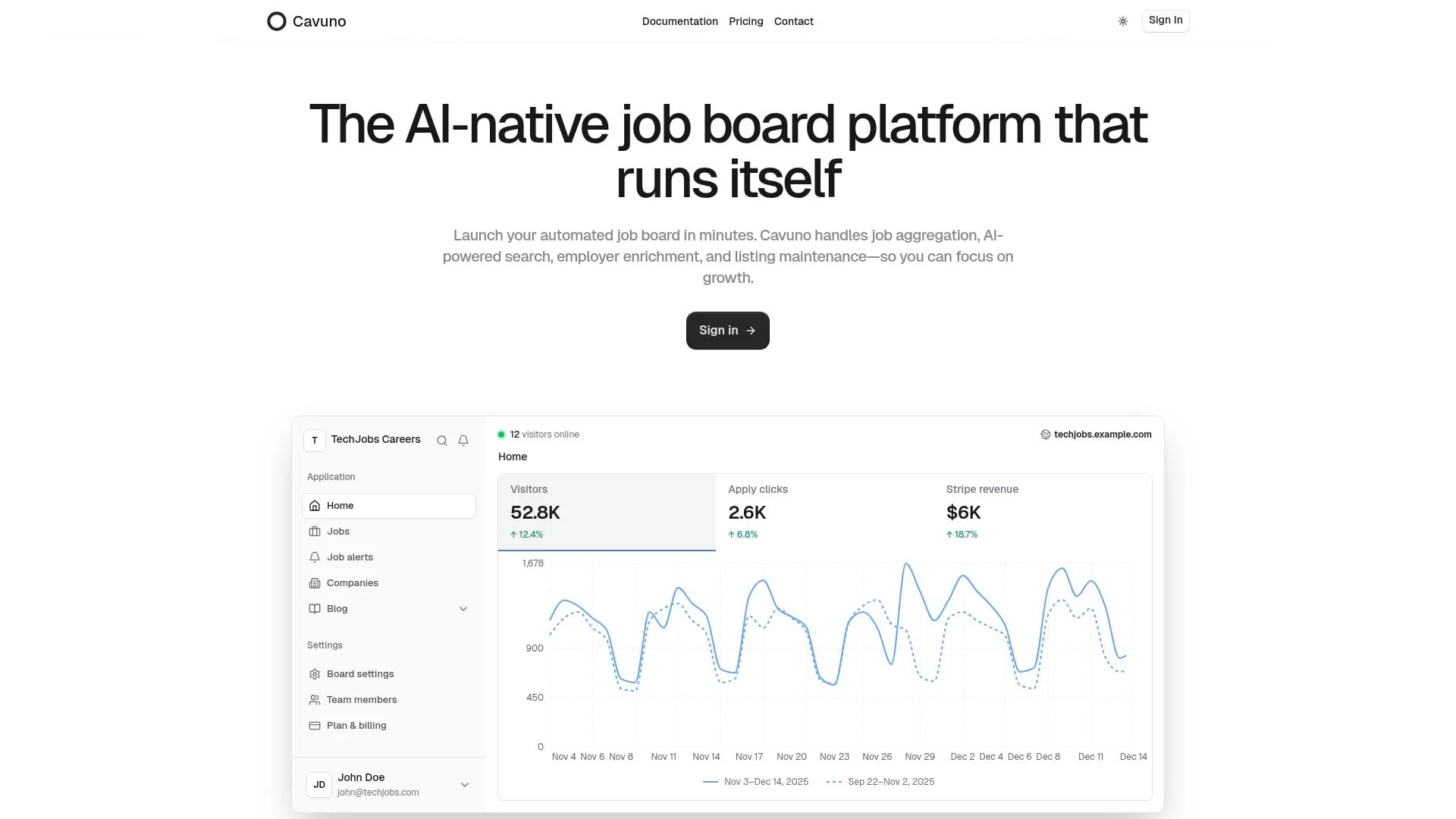
Cavuno is built AI-native from the ground up, not bolted on after the fact. Job aggregation, company enrichment, search ranking, auto-tagging, and duplicate detection all run on AI by default. For associations, this means a career center populated with relevant listings from day one.
What makes it stand out for associations:
- Automated job aggregation solves the cold-start problem. Configure keyword and location filters, and Cavuno imports relevant job openings from employer career pages automatically. Job seekers see a populated board from day one. Launch with 200–500 quality listings before a single employer pays to post. Read more about how job aggregation works.
- Built-in memberships. Sell a membership on the board or assign one from the dashboard. Member pricing shows on the plan cards and applies automatically at checkout, a membership includes posts as one-time credits or live slots plus featured jobs, and member companies carry a public badge. Optionally make posting members-only. Discount codes remain available for promotions. Cavuno keeps memberships in sync with your AMS through the API: your AMS, or an integration the Cavuno team helps set up, assigns and revokes memberships automatically.
- Stripe-powered monetization. Cavuno's standard self-serve subscriptions charge no vendor transaction fee; Stripe processing fees and your operating costs still apply. Enterprise commercial terms are custom.
- Candidate profiles and registration wall help associations turn anonymous job seeker traffic into a member-adjacent talent pool. AI resume parsing, saved jobs, job seeker dashboards, and direct messaging are included on every plan.
- AI job matching gives members a Matches page ranked from their profile and resume, plus an optional weekly matching email. Job alerts remain a separate saved-search digest. Members can use both. Cavuno ranks the list and does not show a match score.
- AI website builder creates and edits any page on your board from a plain-language description, including new pages such as a For employers or members resource page, so you can match your association's brand without hiring a designer. That makes Cavuno the design pick in this guide: your career center does not have to look like every other board on the platform. Custom domain with free SSL included on all paid plans. Customizing does not freeze the site: when Cavuno fixes or improves the starter theme every board is built from, the change is merged into your board around your edits and checked before it goes live.
- Google for Jobs markup is generated automatically. Cavuno adds JobPosting structured data to listings and supports the Google Indexing API. Google determines whether and when a page is indexed or displayed.
- API, CLI, MCP, and webhooks on every paid plan for tech staff who want automation without an Enterprise contract. Connect Claude, Cursor, or Codex via the MCP server, script bulk jobs with the Cavuno CLI, wire your AMS-adjacent workflows through the REST API, or have outbound webhooks push changes to your AMS as they happen instead of polling—most association platforms gate API access to their highest tier.
- Programmatic SEO pages for locations, categories, and companies generate long-tail organic traffic on autopilot.
Pricing: New accounts get a 14-day Starter trial with no card and can publish during it; a paid plan keeps the board public afterward. Starter is $39/mo or $348/year (500 active jobs, unlimited team seats, 1K subscribers). Basic is $105/mo or $948/year and includes footer-branding removal and a custom email sender domain. Existing customers retain their legacy entitlements until they voluntarily switch plans. See all plans and features →
Honest limitations: No automatic AMS membership sync; memberships are managed in the dashboard. Candidate and employer SSO is available on all plans through OpenID Connect or OAuth 2.0, with an Okta setup option. Staff-dashboard SSO/SAML is coming soon.
Best for: Associations that want to operate their own career center and can manage membership status in the dashboard. Members can sign in with SSO through a member system that supports OpenID Connect or OAuth 2.0, including Okta, and webhooks and the REST API connect the board to your AMS. The Cavuno team will help set up the connection to your AMS.
See Cavuno's association features →
YM Careers: best full-service career center for associations
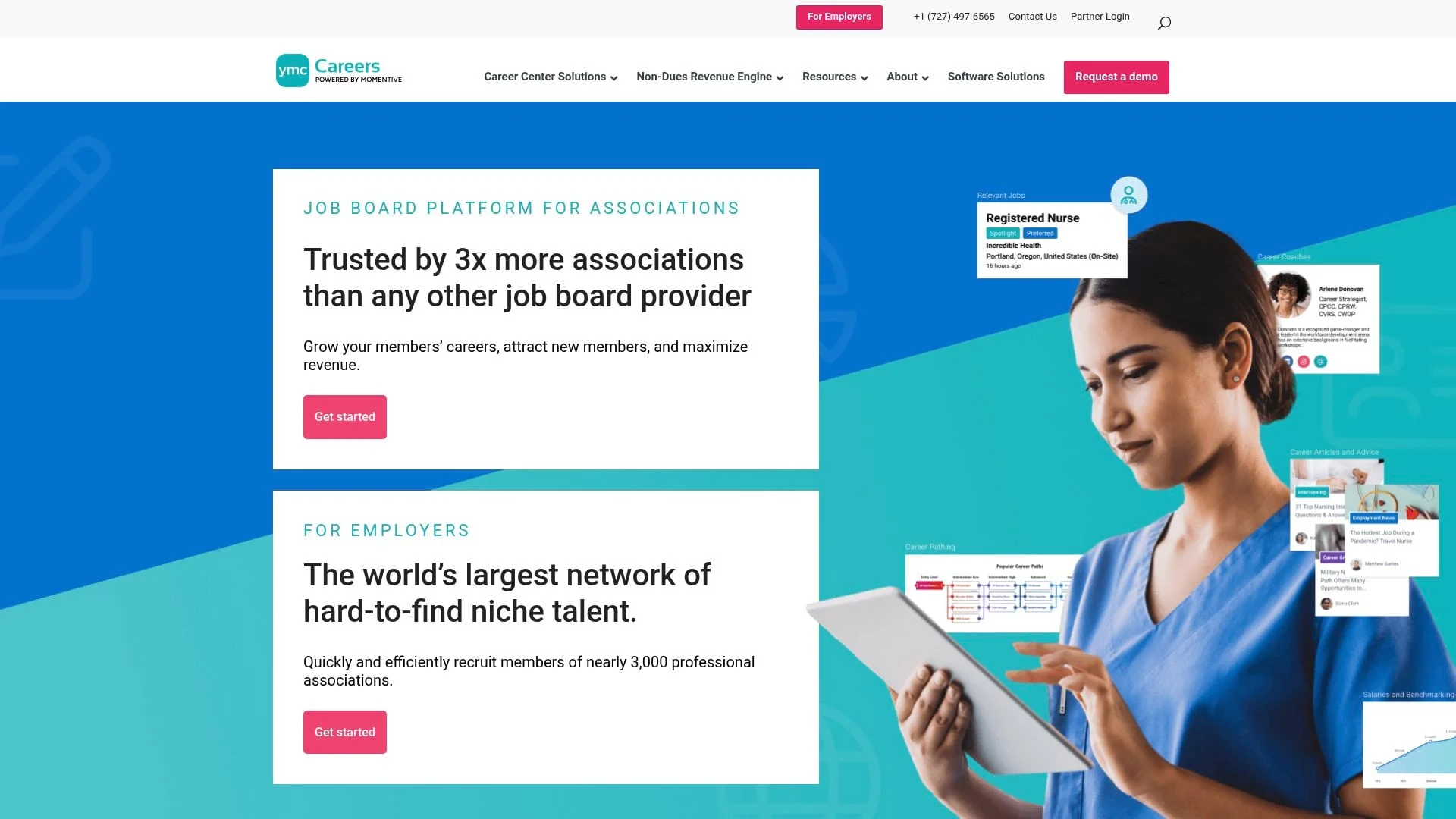
YM Careers is now Momentive Careers. Momentive says it hosts 3x more association career centers than any other platform. If you want a partner that handles employer sales, ask how its operating model, revenue split, and service scope would apply to your association.
What makes it stand out for associations:
- Managed sales. YM Careers provides the platform and the employer sales team. You earn revenue without managing the operation. Pricing is not published, so contact Momentive for setup fees and commercial terms.
- Career Journey tools extend beyond basic job listings into career development, career resources, and skills assessment.
- AMS integration with YourMembership and Nimble AMS, plus member verification and data sync.
- Cross-network job distribution lets employers reach a wider talent pool across multiple association career sites simultaneously.
- AI-powered job summaries and virtual career fairs add member value beyond standard job listings.
SHRM case study: The world's largest HR association achieved seven-figure revenue growth and a 300% increase in employer registrations through YM Careers.
Honest assessment: Unmatched network and sales infrastructure. But pricing is not published, so model the quoted terms against your posting revenue as your career center grows. You're locked into the Momentive ecosystem. Not available as self-serve; requires a sales conversation and implementation timeline.
Best for: Large associations (10,000+ members) wanting hands-off revenue generation with a dedicated employer sales team.
Compare YM Careers vs Cavuno →
SmartJobBoard: best for enterprise associations with AI matching
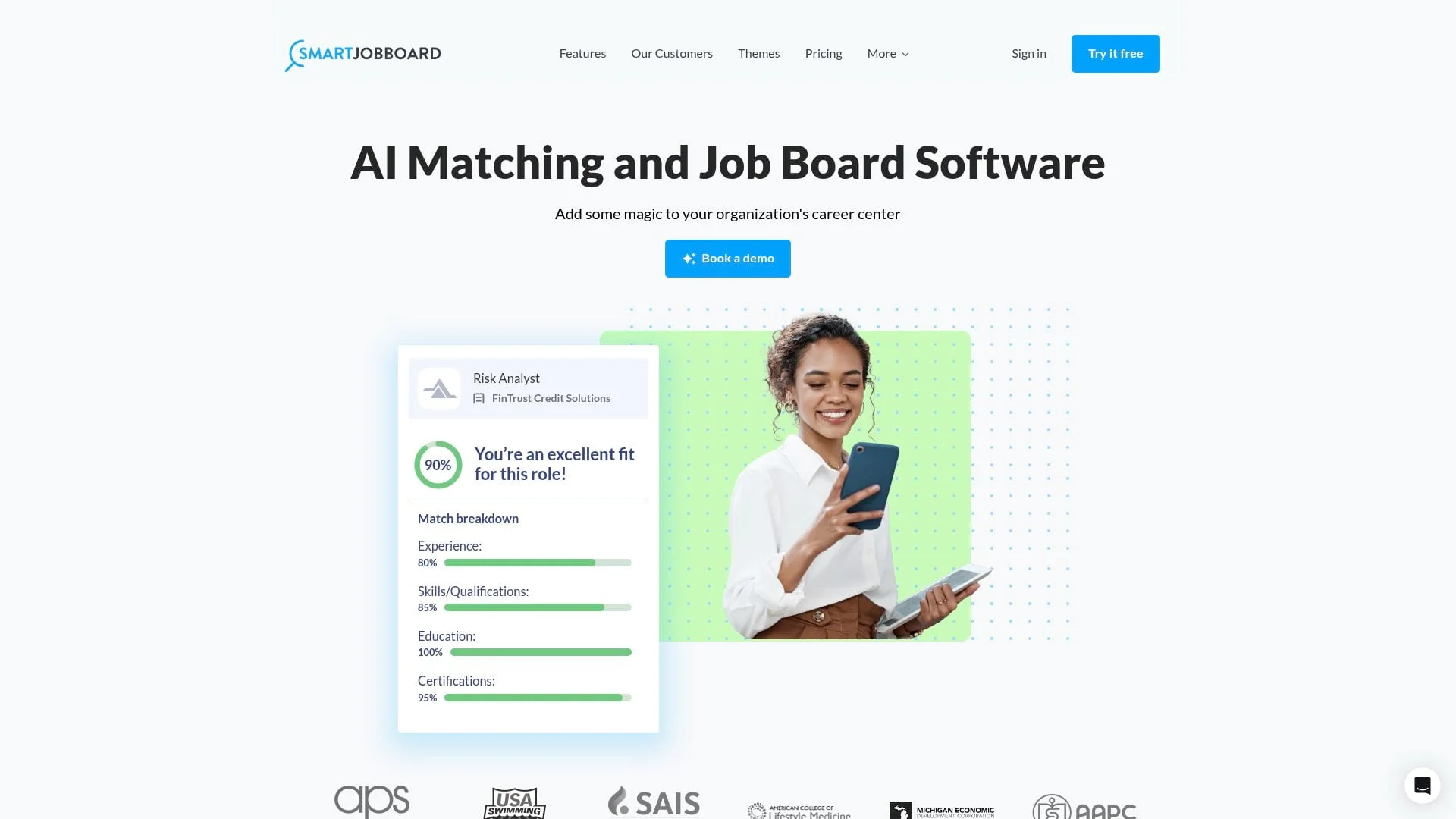
SmartJobBoard has served associations since 2008 and has 400+ organizations on its platform. Their AI-driven job matching goes beyond keyword search to match candidates by skills and experience.
What makes it stand out for associations:
- AI-powered job matching connects job seekers with relevant job opportunities based on skills, experience, and preferences, not just keyword matching.
- SSO and API connections to membership platforms, including NoviAMS.
- Dedicated association career center specialists who understand the nuances of member-based organizations.
- Both revenue-share and flat-fee subscription models, giving associations pricing flexibility.
Named association clients: AAPC, SAIS, ACLM, USA Swimming, IAA.
Pricing: Contact sales. Offers both flat-fee subscription and revenue-share models. No public pricing available.
Honest assessment: Mature, reliable, and capable. The dual pricing model (subscription or revenue share) is useful for associations deciding between the two approaches. But pricing requires a sales conversation. Fewer association clients than YM Careers.
Best for: Mid-to-large associations that want AI matching, SSO and API connections to their membership platform, and a vendor with a long track record.
Compare SmartJobBoard vs Cavuno →
Niceboard: published association case studies
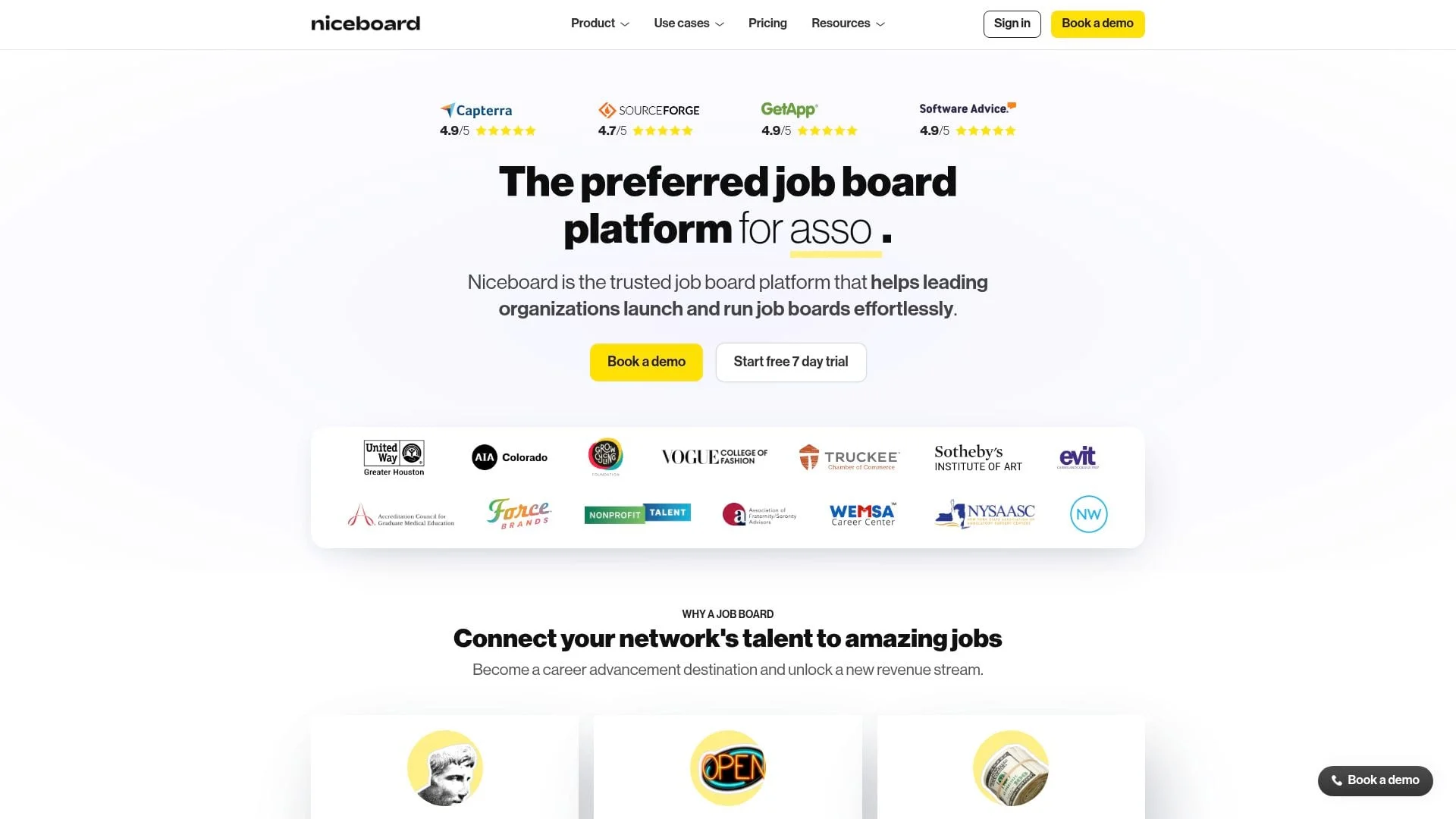
Niceboard publishes association case studies with named clients. It sells one Custom plan, quoted after a demo, with personal onboarding and a managed setup.
What makes it stand out for associations:
- One plan with every feature. The Custom plan includes 30,000 active jobs, 100,000 job seeker accounts, unlimited employer accounts, monetization tools, social login, job alerts, banner ads, and featured companies.
- Published customer examples. Niceboard reports that AIA Colorado generates $50,000–$100,000/year, Medical Alley became profitable in Year 1 while spending 15 minutes per day, and Truckee Chamber of Commerce saves 10 hours per week. Treat these vendor-reported case studies as examples, not benchmarks.
- Coupon codes for member pricing, similar to Cavuno's approach, which work without an AMS integration. Niceboard also publishes AMS integrations (including iMIS and MemberClicks) that let members sign in through SSO, with SSO setup coordinated by its team.
- Stripe integration for straightforward payment processing.
- Advanced association features in the same plan, including web scraping, XML import, Zapier, multi-language support, Google Jobs real-time indexing, employer AI functionality, logo removal, API access, recruiter accounts, SSO, 2FA, and custom email domains.
Named association clients: AIA Colorado, ACGME, Medical Alley, Truckee Chamber of Commerce.
Pricing: Niceboard no longer publishes prices. It sells one Custom plan (30,000 active jobs), quoted after a demo.
Honest assessment: Niceboard combines a polished hosted theme with published association case studies. You need a demo call to get a price, and the plan includes SSO, custom email domains, and Niceboard branding removal. Its pricing page advertises employer AI helpers, web scraping, backfill, and AI job recommendations; verify the exact search and recruiter workflows you need in a demo.
Best for: Associations that want a preset hosted theme, proven association case studies, and SSO, API access, and recruiter accounts in a single sales-quoted plan.
Naylor: ASAE-endorsed career center software
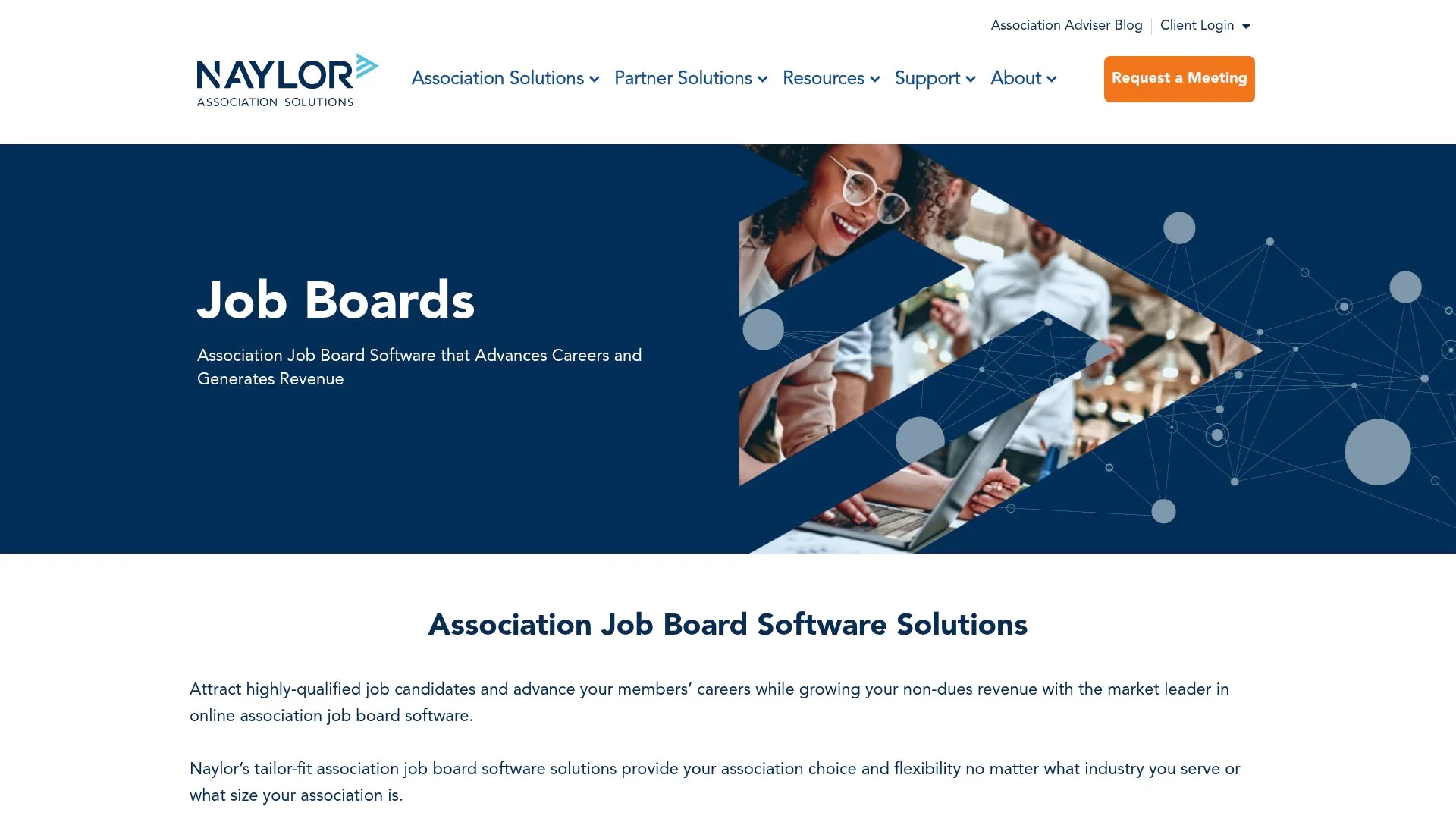
Naylor's career center solution carries ASAE's endorsement, a credential that matters in board-level conversations. Their Career Center Networks model claims to generate 20% more revenue than standalone career sites by sharing employer postings across multiple association job boards.
What makes it stand out for associations:
- ASAE-endorsed solution. Ask Naylor which commercial benefits currently apply to ASAE members.
- Career Center Networks share employer postings across partner associations, increasing the value proposition for employers and generating more revenue per listing.
- Career Pathways professional development tools and AI CareerBriefs newsletter add career-focused content beyond job listings.
- Virtual career fairs and retargeting ads as additional engagement and revenue channels.
Revenue model: Revenue share. Contact Naylor for current setup, revenue-share, and ASAE-member terms.
Honest assessment: The ASAE endorsement carries weight in board conversations. The Career Center Networks model sounds good on paper, but the actual incremental revenue depends heavily on your niche overlap with partner associations.
Best for: Associations already in the ASAE ecosystem who value the endorsement and the career center network model.
Higher Logic Thrive Jobs: career center for community-first associations
Higher Logic Thrive Jobs, powered by Web Scribble, is the only career center product that lives natively inside an online community platform. If your association already runs on Higher Logic Thrive, this is the tightest integration available.
What makes it stand out for associations:
- Single member profile across community and career center. No duplicate accounts, no separate login.
- Jobs appear in community activity feeds, driving organic discovery without extra promotion.
- Native SSO: members are automatically authenticated across community and job board.
- Published launch results include a 25% increase in page views, 14% more searches, and 29% more logins, according to Higher Logic. Treat these as a vendor case example, not a forecast.
Honest assessment: The community-career center integration is unique. No other platform replicates it. But this is only available to Higher Logic Thrive customers. It's not a standalone product. Feature depth as a job board is limited compared to dedicated platforms.
Best for: Associations already using Higher Logic Thrive who want career center functionality embedded in their community.
Web Scribble: association-only career center platform
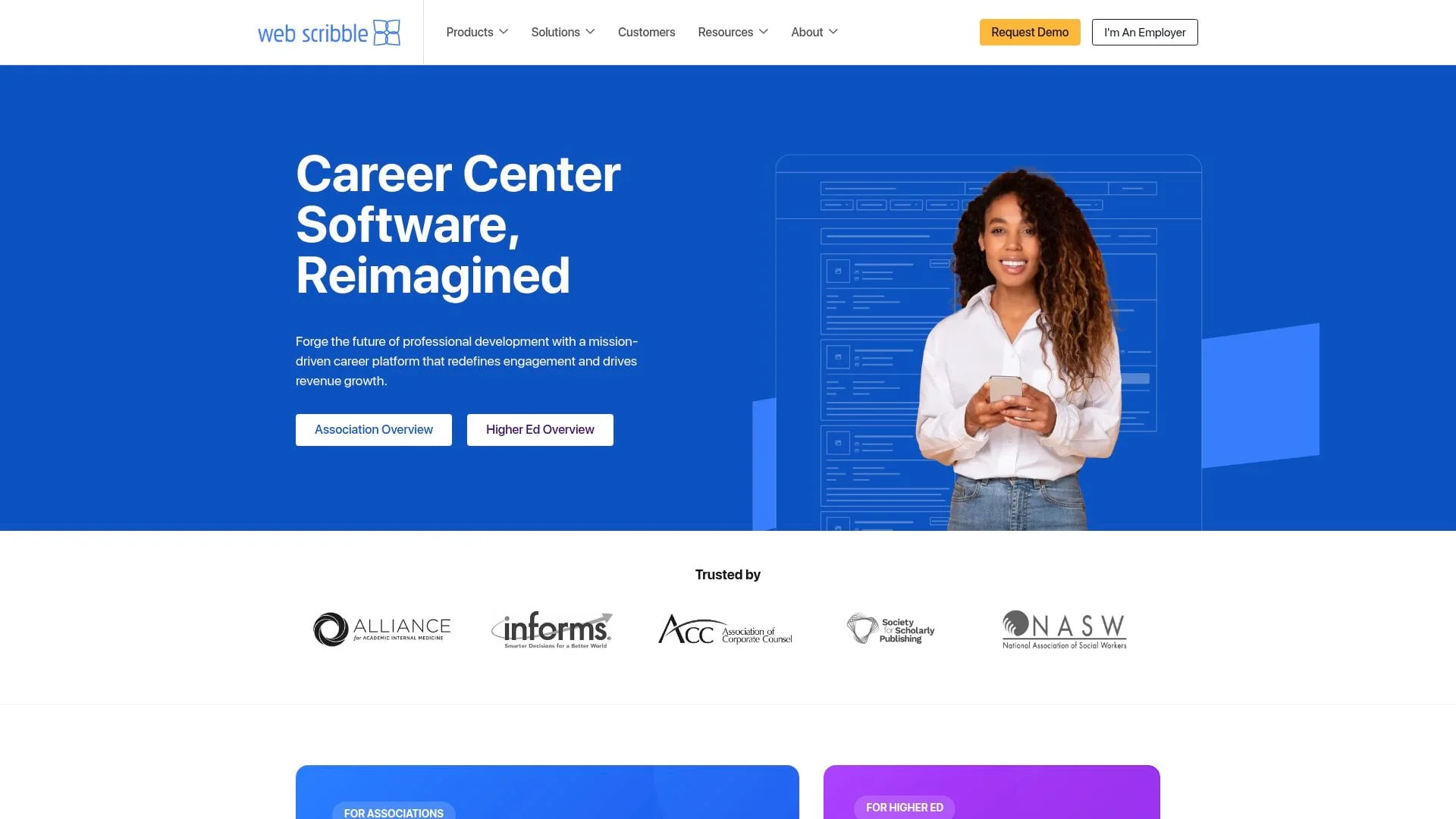
Web Scribble has spent 20 years focused on career centers, serving exclusively associations. They don't do anything else. Their 99% client retention rate and deep career suite (mentoring, career fairs, career resources alongside job listings) reflect that focus.
What makes it stand out for associations:
- 100% association focus. Every feature, every workflow, every support interaction is built for association career centers.
- 41% average increase in non-dues revenue and 37% increase in engagement for clients, per Web Scribble data.
- Full career suite that extends beyond job listings: mentoring programs, virtual career fairs, webinars, and career development resources.
- Native SSO and AMS integration with deep member data connectivity.
- Dedicated association sales team that handles employer outreach.
Named association clients: Association of Corporate Counsel (40% increase in job searches, 50% increase in resume uploads), ASAM.
Honest assessment: If you want a partner who only thinks about association career centers, Web Scribble is it. But there's no pricing transparency, no self-serve option, and no way to evaluate the platform without a sales conversation.
Best for: Mid-to-large associations wanting a dedicated, association-only career center partner with a full career development suite.
Compare Web Scribble vs Cavuno →
JBoard: drag-and-drop editing of its template
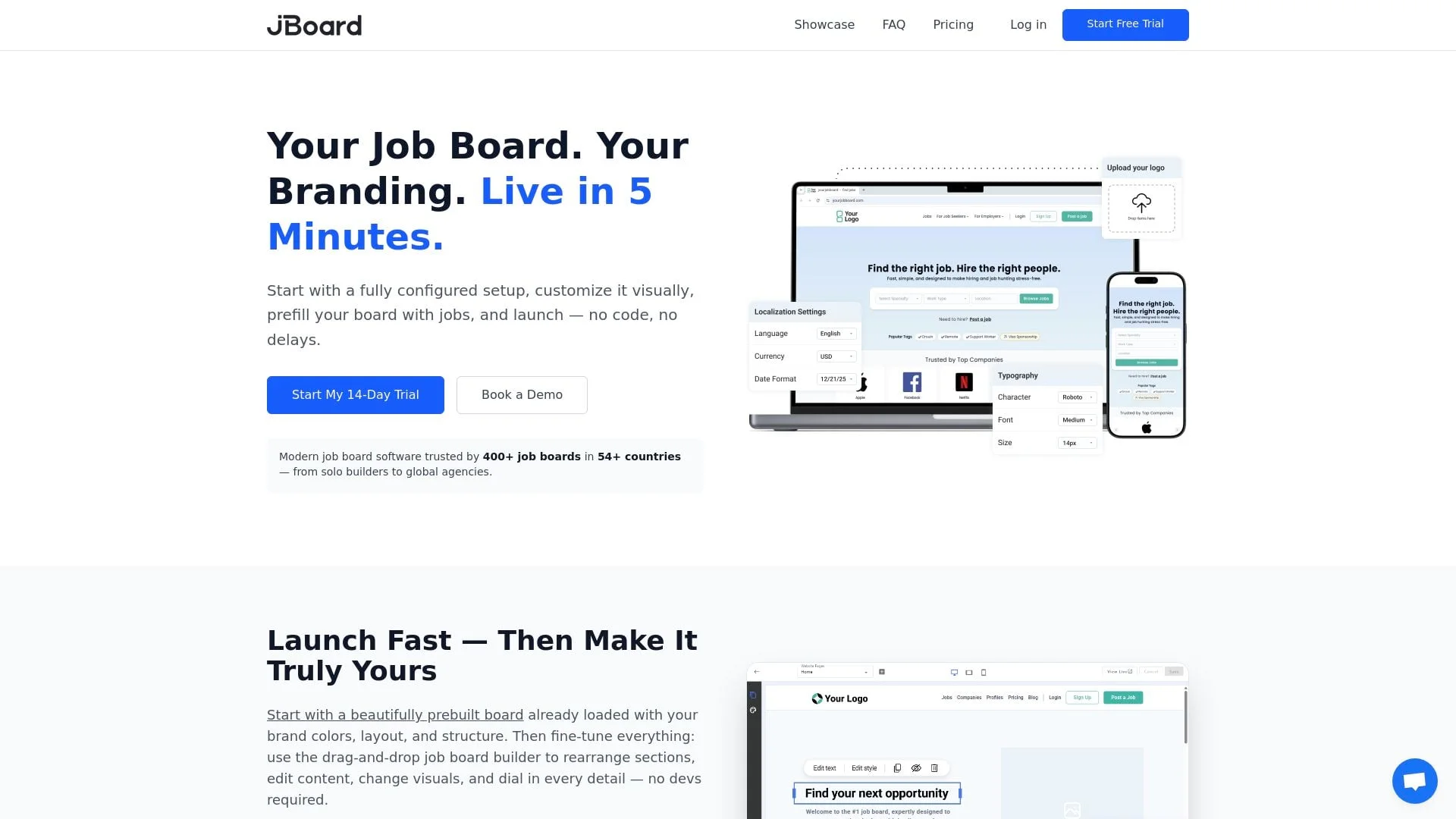
JBoard says it powers more than 500 job boards across 38+ countries, with an emphasis on drag-and-drop editing and no-code scraping tools. The U.S. Chamber of Commerce Foundation uses JBoard for its Hiring Our Heroes program.
What makes it stand out for associations:
- Drag-and-drop website builder for arranging and styling pages within its one flexible template. If your association has specific design requirements beyond the template, Cavuno's AI website builder can change any page or layout and add new pages.
- No-code job scraping from 3 to 80 sources on self-serve plans, automating job population.
- Multi-board management if your association runs separate boards for chapters or regions.
- Multi-board tooling for organizations running separate chapter or regional boards.
Named association clients: U.S. Chamber of Commerce Foundation (Hiring Our Heroes), Canadian Nuclear Association.
Pricing: JBoard lists Basic at $149/month or $119/month billed annually (1,000 jobs, 3 scraper sources, custom domain), Standard at $249/$199 (3,000 jobs, 10 scraper sources), Advanced at $449/$359 (10,000 jobs, 30 sources), and Scale at $849/$679 (30,000 jobs, 80 sources). 14-day free trial.
Honest assessment: JBoard offers a drag-and-drop builder over its template, plus site-wide script snippets for tools like analytics and chat. Discount codes are available on all plans for member pricing, and SSO is available on Scale. AI auto-tagging starts on Advanced. It does not advertise a native AMS integration; verify any identity or member-status connection you require. For more on white-label customization options, see our comparison.
Best for: Associations that want drag-and-drop editing of a template, built-in job scraping, and can manage member pricing independently.
JobBoardly's high-volume plans and Artha's free plan for associations
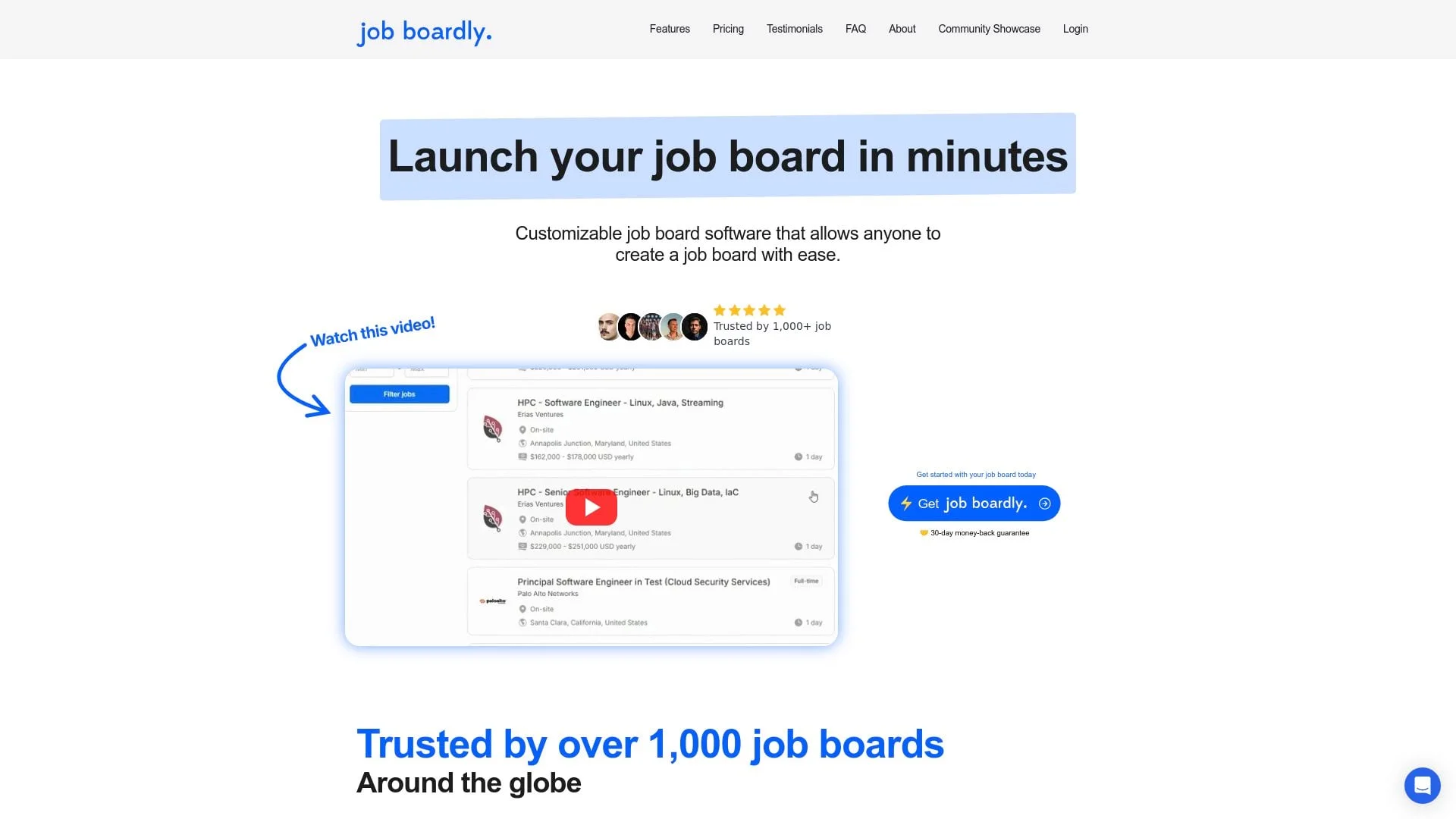
JobBoardly: Published pricing is $60/month for Standard, $120/month for Pro, and $240/month for Ultra ($480/$960/$1,920 per year). Active jobs are capped at 10,000, 20,000, and 50,000 by plan, and candidate and employer profiles are on every plan. Pro adds employer subscriptions, API access, and branding removal; Ultra adds a headless API, in-product messaging, and priority support. It does not advertise a native AMS or SSO integration; confirm member-discount workflows in a demo.
Artha: Published pricing is Free, Growth at $79/month or $65/month billed annually, and Scale at $149/$120. Scale adds AI candidate matching, resume parsing, and smart search. Confirm candidate and active-job allowances for your expected volume.
Best for: Small associations or chapters that want to test the job board concept on Artha's free plan before committing to a paid platform. JobBoardly suits boards that need a high active-job cap; its plans start at $60/month, above Cavuno Starter's $39/month.
Compare JobBoardly vs Cavuno → | Compare Artha vs Cavuno →
Careerleaf: job board software for multi-chapter associations
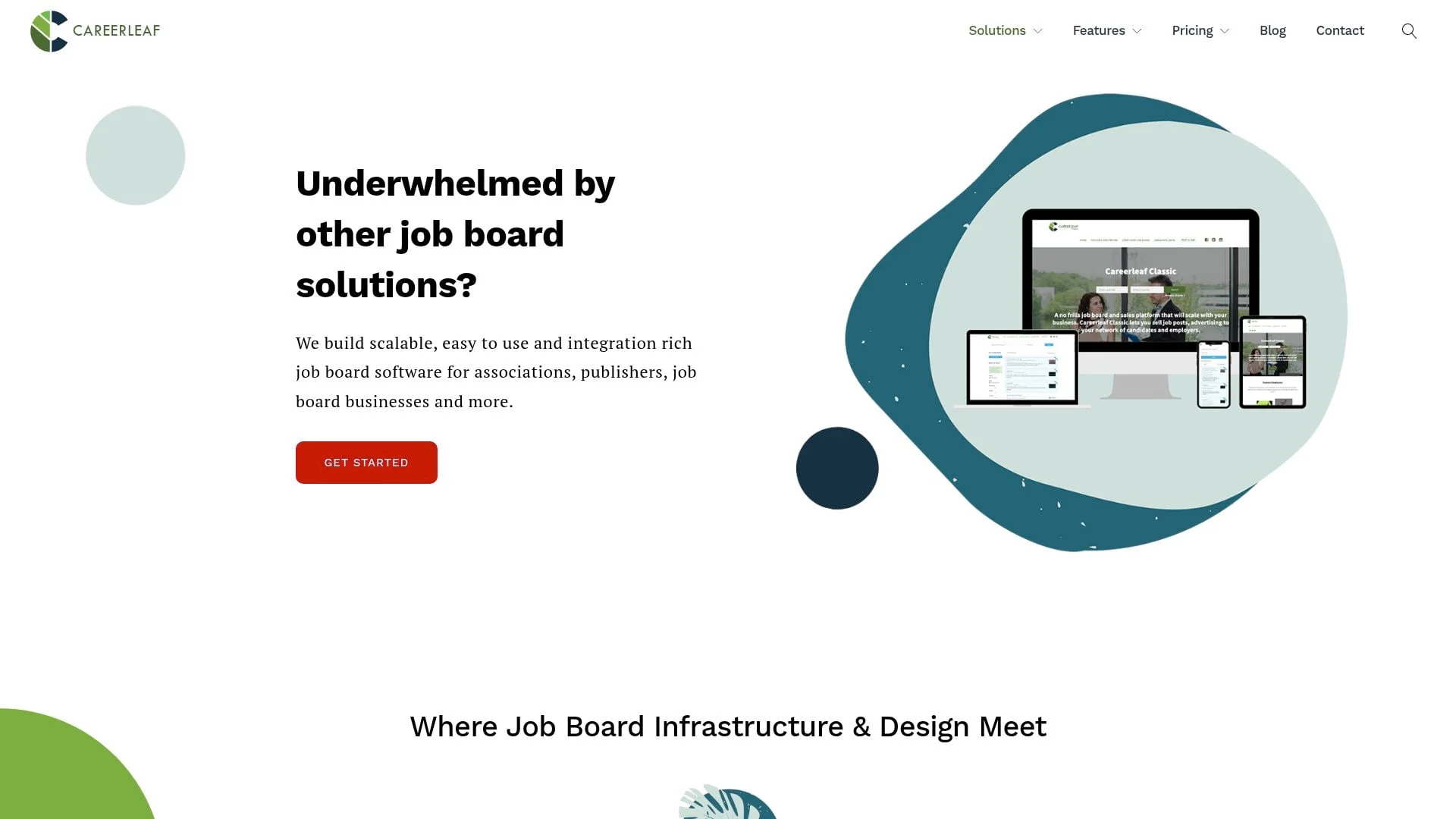
Careerleaf is a dedicated job board platform built specifically for associations and membership organizations. It offers integrations with Salesforce, AgileCRM, Google Analytics, Google Tag Manager, and SkyPrep, plus membership-database SSO from $550 on Classic and above, an applicant tracking system on Classic and Corporate (an add-on elsewhere), backfill and free integrated CRM and email marketing on every plan, and branded member experiences. Several large associations use it for career center operations.
Pricing: Careerleaf’s job-board plans start with Publisher at $300/month plus $750 setup and Classic at $349/month plus $850 setup. Community, designed for associations, chambers and communities, costs $549/month plus $5,000 setup. Community does not include the applicant tracking system; Classic and the separate Corporate product do. Corporate is white labelled and adds approvals, WordPress CMS and data migration, with subsidiary-based pricing.
Honest assessment: Purpose-built for associations, with membership-database SSO from $550 on Classic and above. But the Community plan's $5,000 setup fee is a barrier compared to self-serve platforms. No self-serve option or free trial.
Best for: Mid-to-large associations that want an association-focused vendor with membership-database SSO and are willing to invest in setup.
Compare Careerleaf vs Cavuno →
MemberClicks, SilkStart, and Rhythm: AMS job board add-ons
If you're already on one of these AMS platforms, their built-in job board modules may be sufficient, especially if you prioritize operational simplicity over feature depth.
MemberClicks: Job board add-on integrated with their AMS. Resume bank. Member-only vs. public listing controls. Native SSO. Good enough for associations that want basic career center functionality without adding another vendor.
Rhythm Software: Career center feature within their AMS platform. Focused on the trade association and chamber of commerce market. Limited job board feature set compared to dedicated platforms.
SilkStart: Basic job board within their membership management platform. Member pricing and posting controls included. Suitable for small associations with simple requirements.
Honest assessment: These add-ons work if your association treats the career center as a secondary feature. If non-dues revenue from job postings is a strategic priority, dedicated platforms outperform AMS add-ons on design quality, SEO, employer experience, and revenue tooling.
What to look for in association career center software
Use the following as an example scoring framework, then change the weights around your requirements. Treat a mandatory integration or access requirement as a pass/fail gate before scoring. These weights are not measured vendor scores:
- Non-dues revenue potential (25%): Member/non-member pricing, multiple revenue streams (postings, subscriptions, resume database, featured listings), and the net proceeds after platform and payment fees
- Speed to launch (15%): Verify a launch plan covering migration, integrations, content, payment setup, and acceptance testing
- Member experience and design (15%): Your career center reflects your association's brand. Look for custom branding, mobile devices support, and a user experience that matches your main website
- Ease of ongoing operations (10%): Time your own moderation, support, sales, and reporting workflows during a trial; evaluate whether alerts and employer self-service reduce that workload
- AMS and SSO integration (10%): Verify identity, member status, renewal, and expired-member behavior with your actual membership system
- SEO and Google for Jobs compliance (10%): Check crawlable job pages, valid JobPosting markup, sitemaps, expiry handling, and useful landing pages. Submission tools do not guarantee visibility
- AI and automation (10%): Job matching, auto-tagging, aggregation filtering, and duplicate detection reduce ongoing management time
- Pricing and total cost of ownership (5%): Monthly subscription, setup fees, per-transaction fees, revenue-share percentages, and scaling costs
For a full buyer's framework, see our job board software buyer's guide.
Shortlist full-service partners if outsourced employer sales is a requirement. Shortlist self-serve software if your team wants to run sales and operations itself. For Cavuno, confirm the features and limits in the current plans against your requirements.
How to pitch a job board to your association's board of directors
Picking the right software is only half the challenge. Most association executives also need board approval before they can launch a career center. Every competing article skips this step. We wrote an entire guide to getting board approval for your association job board. Here's the condensed version.
Association job board business case template
Your board doesn't want a software demo. They want three numbers: how much it costs, how much it makes, and how soon.
Cost:
- SaaS platforms (Cavuno, JBoard): $39–$849/month; Niceboard quotes its price after a demo
- Managed-sales models (YM Careers, Naylor): setup fees and revenue splits may apply; get the terms in writing
- Custom development: $50,000–$100,000+
Revenue scenarios: Present low, middle, and high cases using paid postings per month × collected price × 12. Label them hypothetical, show assumptions, and distinguish annual gross revenue from profit. Use named case studies as vendor-reported examples rather than general benchmarks.
Break-even analysis: Include the applicable platform tier, add-ons, payment processing, revenue share, staff time, marketing, refunds, and tax. There is no universal number of postings or timeline that guarantees profitability.
Time investment: Budget setup and ongoing employer support separately. In Niceboard's AIA Colorado case study, the named staff member reports around two hours per week of check-ins. That is one vendor-reported example, not a staffing allowance for every association.
Member value: State the member problem the career center should solve, then measure searches, alerts, applications, employer participation, and renewals during a pilot. For the full career center flywheel framework, see our guide to increasing association membership.
Common objections to launching an association job board
"We don't have the staff." Automated aggregation fills the board with relevant jobs from day one. Employer self-service handles posting, payment, and renewals. The same AIA Colorado case study reports around two hours per week for the named staff member. Estimate your own moderation, membership operations, sales, support, and promotion time before allocating staff.
"What if nobody uses it?" Test demand before making a forecast. Interview employers, survey members, run a pilot, and promote it through your newsletter, events, and existing employer relationships. Valid JobPosting markup can make individual job pages eligible for Google's job search experience, but discovery is not guaranteed. Our niche validation framework shows how to test employer willingness to pay.
"We already post jobs in our newsletter." A career center gives readers a searchable destination between newsletter sends and can support employer self-service, featured listings, and recurring packages. The newsletter remains a distribution channel. Test whether those capabilities increase paid postings, relevant applications, and member use before forecasting incremental revenue or retention.
The lowest-risk path: start with Cavuno's $39/month plan, aggregate up to 500 jobs in your niche, and show the board real traffic data after 30 days. If the data supports it, upgrade and scale. If not, you've spent less than the cost of a single board lunch. Start free →
Launch your association job board
Your association's members are already searching for open positions. The question isn't whether they need a career center. It's whether they'll use yours or LinkedIn's.
Choose an operating model, verify the member and expired-member journeys, assign the sales work, and model total cost against conservative paid-posting scenarios. Then pilot the board and scale only when employer and member behavior supports it.
If you're a large association wanting a hands-off revenue partner, talk to YM Careers or Naylor. If you want to own 100% of revenue, launch fast, and keep costs low while you prove the model, start with Cavuno. Free, no credit card, no sales call.