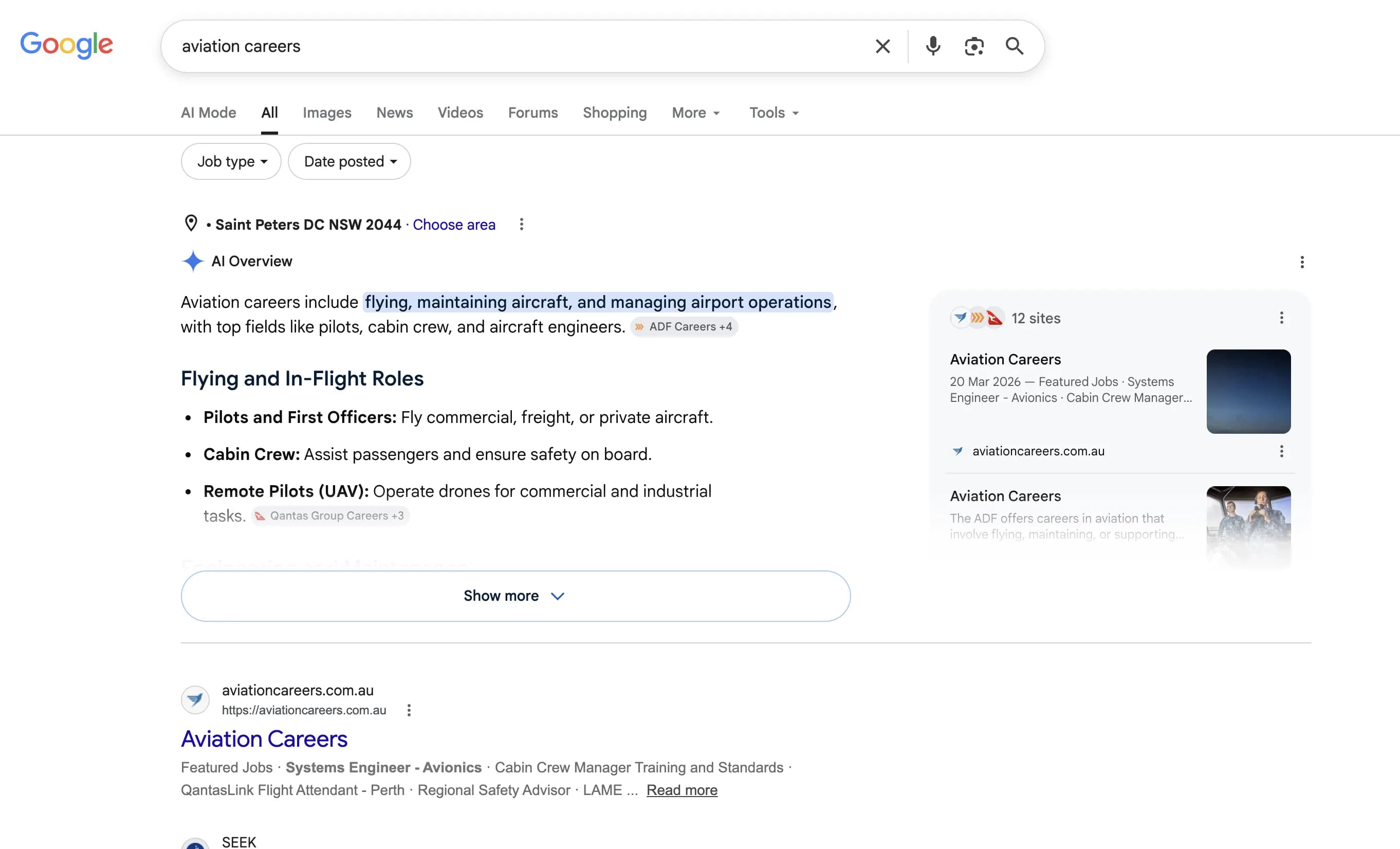
Aviation Careers appears in Google’s AI Overview source panel and as the first traditional organic result in this Australian search.
“I'm already ranking well in Google despite it being a new site.”
One destination for Australian aviation work
Aviation Careers brings together jobs and practical career guidance across airlines, airports, aerospace and defence, maintenance, training, cabin crew, ground operations, and the wider aviation ecosystem.
Duke set up and manages the board in Cavuno without stitching together a collection of extra tools. Jobs, company profiles, the blog, and job alerts all support the same candidate experience.
The public board is designed around how candidates actually explore a career market: current roles, employer profiles, salary data, location pages, related searches, job alerts, and in-depth editorial content. None of that existed when the domain was registered.
The board could not launch empty
Aviation Careers launched with a blank domain, no established audience, and no search footprint. That created a familiar marketplace problem: candidates would not return to a thin job board, employers had little reason to promote listings on a site without candidates, and Google had little reason to rank pages without useful, current inventory.
The first objective was therefore not monetization. It was to create a credible destination for Australian aviation work—deep enough to help a candidate and focused enough for search engines to understand.
Using AI Backfill to make the board useful
When Aviation Careers was created, Cavuno generated initial AI Backfill rules from the board's aviation focus. Those rules defined the roles and filters that belonged on the site, then sourced matching jobs from supported company career pages.
Backfill did more than seed the launch. It continued importing newly available roles, deduplicating them by source, and expiring listings that disappeared from their original career page. Company enrichment supplied logos and useful profile information so candidates could explore the employers behind the jobs.
Duke puts it plainly: Cavuno saves me about an hour a day—and it keeps working even when I'm flying.
Coverage keeps improving
Cavuno does not yet cover every source Duke uses. Some union-specific aviation job boards sit outside the built-in scraper. For those sources, Duke uses Cavuno's MCP with Codex to capture and publish the missing jobs automatically instead of entering each one by hand.
“The job scraper has also gotten better over time, and when I send feedback, the devs usually reply quickly and fix things. I'm really surprised with the quality of the jobs it finds given my niche (aviation careers in Australia).”
AI Backfill handles the repeatable coverage, the MCP-and-Codex workflow fills the remaining gaps, and the built-in scraper keeps getting better.
Turning live inventory into a destination
The live site turned that inventory into more than a feed of listings. Candidates could use AI-ranked job and company results, browse location pages and related searches, compare salary data, and subscribe to job alerts that gave them a reason to return. Individual job and employer pages created a distinct, useful path for each role and company.
Duke used Cavuno's built-in blog to publish guides covering pilot licences, flight attendant work, aviation rescue firefighting, and Airservices Australia aptitude testing. Each job, company, and guide expanded the search footprint while reinforcing one clear topic: Australian aviation careers.
Search visibility followed usefulness
In its first seven months, Aviation Careers reached 555,600 Google impressions, attracted 34,100 visitors, and generated 64,000 page views. These are cumulative results from launch through 28 July 2026.
The board became the first traditional organic result for the category-defining search “aviation careers” in an Australian Google result. It also appeared as a source in Google's AI Overview for the same query.
Why the result compounded
- A coherent niche: every job, employer, and article reinforced one clear topic.
- Useful inventory: aggregation gave candidates a meaningful board from the start.
- Search coverage: jobs, companies, locations, salaries, and guides covered the candidate journey.
A stronger offer for employers
Aviation Careers now has what an empty board does not: a visible audience, measurable candidate traffic, and relationships to hundreds of employers already represented on the site. That gives the operator a credible foundation for direct employer outreach, featured listings, paid posting packages, and sponsorship.
The audience had also started generating revenue through Google AdSense within seven months—a small but tangible sign that the site could monetize its traffic while Duke built out the employer side.